Fixed-term lease in Zurich: rights, deadlines, sublets

Before you sign
A fixed-term lease ends on the agreed date, without notice. Until then, the landlord can't give you ordinary notice and usually can't raise the rent. You can only get out early by finding an acceptable replacement tenant. You can ask the conciliation authority for more time, at least 60 days before the end date, unless the lease is expressly limited to the period before the building is demolished.
On 1 June 2026, the city of Zurich had just 252 vacant flats, 0.11 percent of its housing stock. Search in this market and you soon come across offers for a limited time: a flat in a building due to be torn down in two years, a room for one semester, or the home of someone spending a year abroad. These offers are often cheaper and quicker to get. We show what rights you have, which deadlines count and where the risks are, based on the Swiss Code of Obligations and the practice of the Zurich courts. We link the English translation of the Code on Fedlex; the court, city and police pages we link are in German only.
Fixed term or just a minimum term?
A lease only has a fixed term if it is meant to end on a set day by itself. That is how Art. 255 CO defines it: leases have a limited duration "where the intention is that they should end without notice on expiry of the agreed duration". Every other lease counts as open-ended.
This distinction matters more than it looks. Some leases state a minimum term, say two years. That doesn't make them fixed-term. The Zurich courts explain a minimum term as a longer notice period, which is allowed because the law only sets minimum periods. A lease like this only ends when someone gives notice, and the landlord has to use the official form to do so. That gives you full protection against termination: you can challenge the notice and ask for an extension.
So read carefully what the lease says should happen at the end of the term. If it says it "ends on 31 January 2028 without notice being required", it's fixed-term. If it says it "can be terminated with effect from 31 January 2028 at the earliest", it's open-ended with a minimum term. The table below shows what this means for the most common kinds of temporary housing:
| Lease | How it ends | Extension | Leaving early |
|---|---|---|---|
| Open-ended, minimum term | Notice, 3 months | Yes | Replacement tenant |
| Fixed-term | On the end date | Yes, ask 60 days before | Replacement tenant |
| Fixed-term until demolition | On the end date | No | Replacement tenant |
| Sublet | Depends on the lease | Only as long as the main lease | Replacement tenant |
Shorter periods apply to a furnished room, more on that below. First, what applies during a fixed term.
What applies during the lease
During the fixed term, both sides are bound. The law only provides for ordinary notice on open-ended leases (Art. 266a CO). So your landlord can't decide halfway through that they would rather use the flat themselves. Only extraordinary termination remains possible, for example if you fall behind with the rent.
The rent stays as it is, too. By law, an increase is only possible for the next termination date, and a fixed-term lease doesn't have one. The Zurich courts say on their page on rent increases that during a fixed term, a rent increase is in principle not allowed. The exceptions are an indexed rent, which is only valid for a term of at least five years, and a graduated rent, which needs a term of at least three years and fixed amounts in francs. If a clause like that sits in a one-year lease, it's invalid.
The rest of your protection as a tenant applies in full. The deposit can't be more than three months' rent and must be held in a bank account in your name (Art. 257e CO). In the canton of Zurich, the landlord must also tell you the initial rent and what the previous tenant paid, on an official form. This applies to every new residential lease as long as less than 1.5 percent of homes in the canton are vacant. On 1 June 2026, the figure was 0.52 percent. If you think the initial rent is unfair, you have 30 days after taking over the flat to challenge it at the conciliation authority (Schlichtungsbehörde). To see whether a rent is normal for the area, read our overview of rents by district.
That leaves the question of what you can do if you want to leave early yourself.
Can I end a fixed-term lease early?
No, you can't give ordinary notice on it. Your way out is Art. 264 CO: you propose a new tenant who is solvent, whom the landlord can reasonably accept and who will take over the lease on the same terms. Without that person, you pay the rent until the end date.
The Zurich courts explain how strict this is on their page on handing back a flat early. As a rule of thumb for solvency, the rent shouldn't be more than a third of the person's net income. One good candidate is enough, but you carry the risk of them pulling out. The landlord normally needs 10 to 30 days to check the documents. If they turn down an acceptable replacement tenant, you owe no more rent from the day that person would have moved in.
A new job, by the way, is not a "good cause" that would let you end the lease on extraordinary grounds. The Federal Supreme Court decided this in 1994, as the tenants' association, the Mieterinnen- und Mieterverband, reports. So with a fixed-term lease, plan from the start on the replacement-tenant route. You have more room to manoeuvre at the other end of the lease.
At the end: move out, extend or stay
On the end date, the lease is over, with no letter and no form. That's what Art. 266 CO says. If you haven't found a new flat by then, you have two options, and the first comes with a deadline that many people miss.
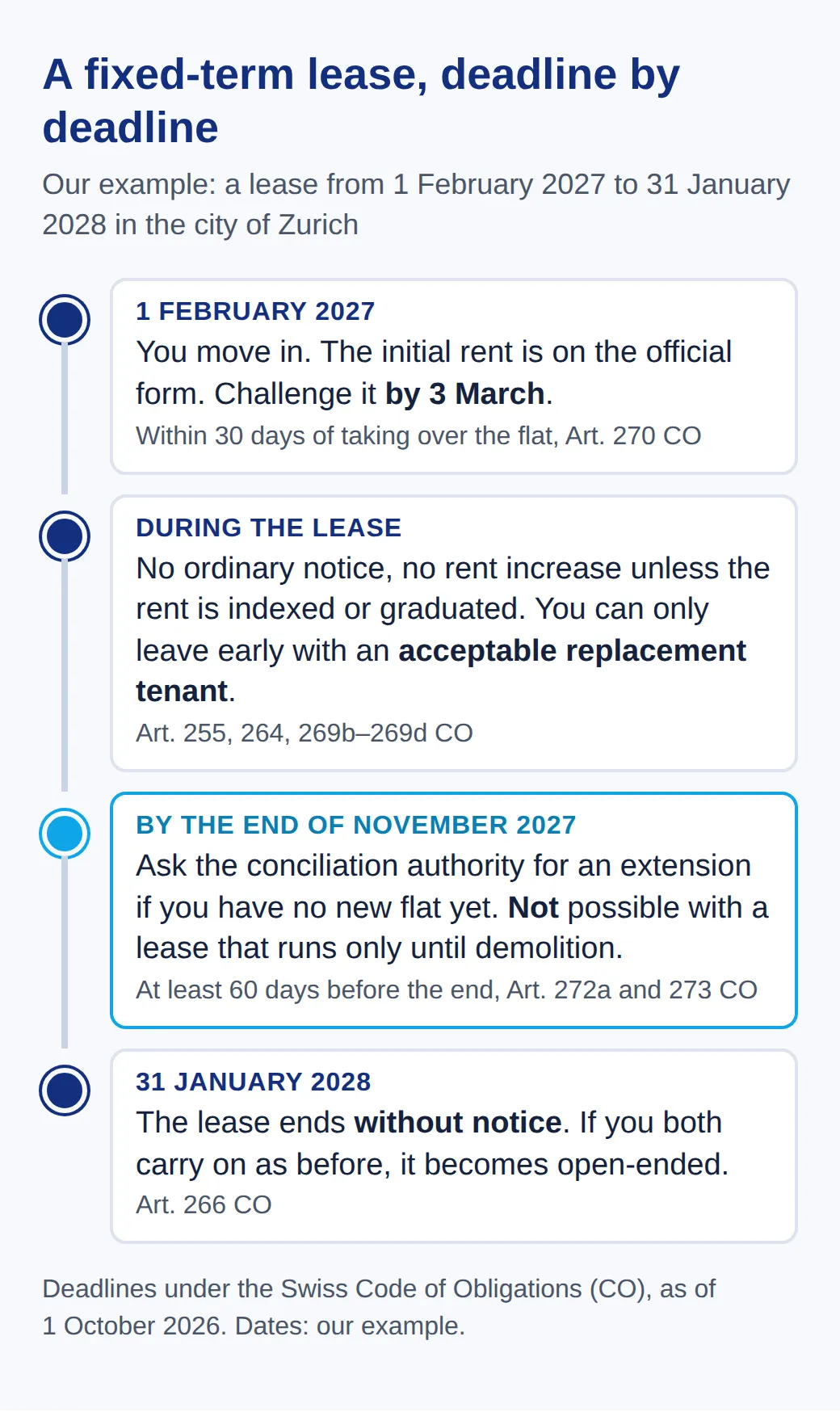
The first is an extension. If the end of the lease would cause hardship for you or your family that the landlord's interests can't justify, the conciliation authority extends it (Art. 272 CO). The law explicitly includes fixed-term leases. For flats, the total is four years at most, in one or two steps. The tenants' association points out in its tips on notice for a full renovation that this maximum is rarely granted, and certainly not the first time round. With a fixed-term lease, you must file your request no later than 60 days before it ends. If you only realise in the last month that time is running short, you're too late.
What counts as hardship is decided case by case. On their page on extensions, the Zurich courts mainly list financial, work and family reasons, and they advise keeping proof of your search efforts, because it is the best evidence of hardship. So save every application and every rejection, from the day you start looking.
The second option often comes about without anyone intending it. If you and the landlord tacitly carry on after the end date, say because you stay and the landlord keeps accepting the rent, the fixed-term lease becomes open-ended. From then on the normal rules apply: three months' notice for a date set by the lease or by local custom. According to the tenants' association, the city of Zurich has only two customary termination dates a year. But what if the landlord simply lines up one lease after another so that it never gets that far?
Back-to-back leases: when a fixed term doesn't count
Several fixed-term leases in a row are allowed in principle. The fixed term only becomes invalid if its sole purpose is to get around tenant protection, and you have to prove that. The Federal Supreme Court ruled this in 2013 (BGE 139 III 145).
The case shows how high that bar is. A tenant had come to Geneva from Spain in 2004 with a one-year employment contract. He and later a flatmate, also on one-year contracts, rented the same flat under several fixed-term leases in a row. At the start of 2009, the landlord offered one last year, expressly without renewal. The tenants then said themselves that they had to return to Spain at the end of June 2010, and were given a lease to that date. The Geneva cantonal court saw this as getting around the law and declared the lease open-ended. The Federal Supreme Court overturned that: the law doesn't require any particular reason for a fixed term, and given the tenants' insecure jobs, no attempt to get around the rules had been proven. The lease ended on 30 June 2010.
Still, the ruling isn't useless for tenants. The court also held that a housing shortage and a landlord's policy of only letting on fixed terms can be signs of an attempt to get around the law. If you're signing a one-year lease for the same flat in Zurich for the third time, without ever having asked for a fixed term yourself, talk it through with an advice service. Keep every lease and the emails around each renewal for that. Things are clearer when the reason for the fixed term is on the building plans.
Living there until demolition
Some of the fixed-term offers in Zurich are in buildings that will be demolished or fully renovated. A hard rule applies to these leases: there is no extension for a lease "expressly concluded for a limited period until refurbishment or demolition works begin or the requisite planning permission is obtained" (Art. 272a CO).
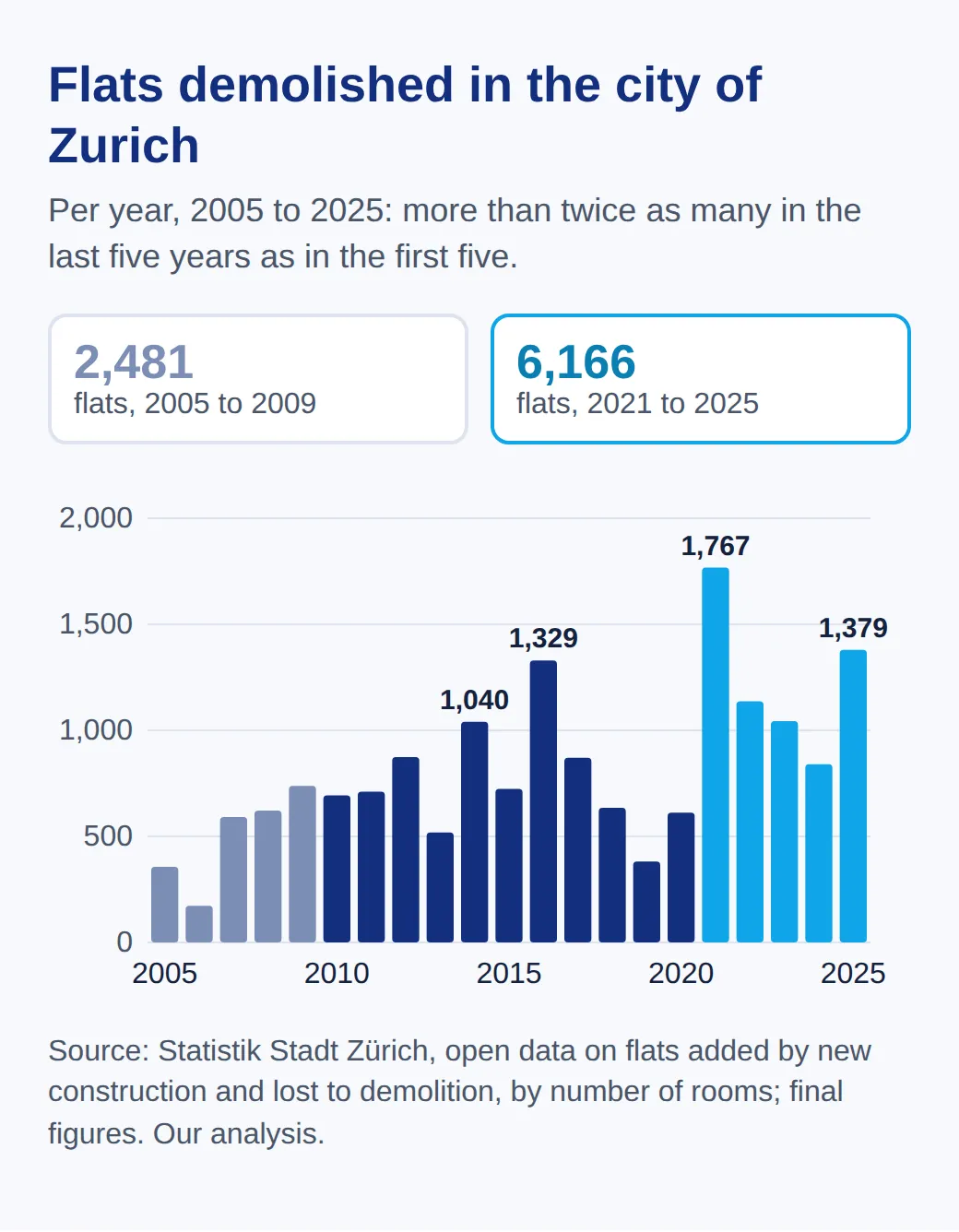
And buildings like these have become more common in Zurich. We analysed the open data from Statistik Stadt Zürich on new construction and demolition. From 2021 to 2025, 6,166 flats were demolished in the city, more than twice as many as the 2,481 from 2005 to 2009, and a good 60 percent more than the 3,828 in the five years before. In 2025 alone, the figure was 1,379. The years can't be compared exactly: since 2021, the city has kept a new register of buildings and dwellings, so some figures may differ from earlier counts. The upward trend is clear all the same.
It often takes a while before the diggers arrive, and owners who don't want empty buildings keep letting them on fixed terms. The Jugendwohnnetz JUWO, a youth housing network, is set up for exactly this. By its own account, it rents properties for a limited time that are due for renovation in the foreseeable future, and promises owners that the buildings stay lived in and the residents move out on time. It sublets the space to young adults. According to the JUWO criteria, you can rent from it if you are 16 to 28 years old, earn no more than CHF 30,000 a year and are in education, such as studying, an apprenticeship or an internship. Vacant flats aren't advertised publicly; offers come through an account on the JUWO portal. Cooperatives also let flats on fixed terms before a replacement building goes up; how that works and what it means for membership is in our post on cooperative flats in Zurich.
Check three things with an offer like this. Does the lease name the building project explicitly? Only then is an extension ruled out. Is there a fixed end date, or does the lease end "when construction starts", which can move? And how long is the notice period if building starts earlier? Either way, expect to move out at the end without an extension, and start looking for your next flat well in advance. Things look quite different if you take over another tenant's flat.
Sublets: living in someone else's flat
In a temporary sublet, you don't rent from the owner but from the person who is the tenant. Legally, this is a sublease under Art. 262 CO, and it needs the property manager's consent. Without that consent, your home is only as secure as someone else's lease.
The property manager can only refuse consent for three reasons: if they aren't told the terms, if the terms are unfair, or if the sublet causes them major disadvantages. The Zurich courts add two points from case law that matter to you as a subtenant. First, the main tenant may not make a profit from the sublet that their own contribution doesn't justify. Second, the property manager can say no if someone passes on the whole flat indefinitely with no intention of coming back. So a temporary sublet is only above board if the main tenant really does return. Anyone who sublets without consent risks being given notice, in the worst case extraordinary notice.
How much rent is fair depends on the space. For one room in a three-room flat with a shared kitchen and bathroom, the tenants' association suggests in its tips on subletting about a third of the total rent, if the rooms are of similar size. If someone asks much more for a furnished flat than they pay themselves, that's a warning sign.
Tighter rules apply to flats owned by the city. Under the City of Zurich's letting terms, a whole flat may be sublet for one year at most and only once in five years, with written consent from Liegenschaften Stadt Zürich, the city's property department. A single room may be sublet indefinitely, again only with consent. Repeated short sublets, including through online platforms, are not allowed.
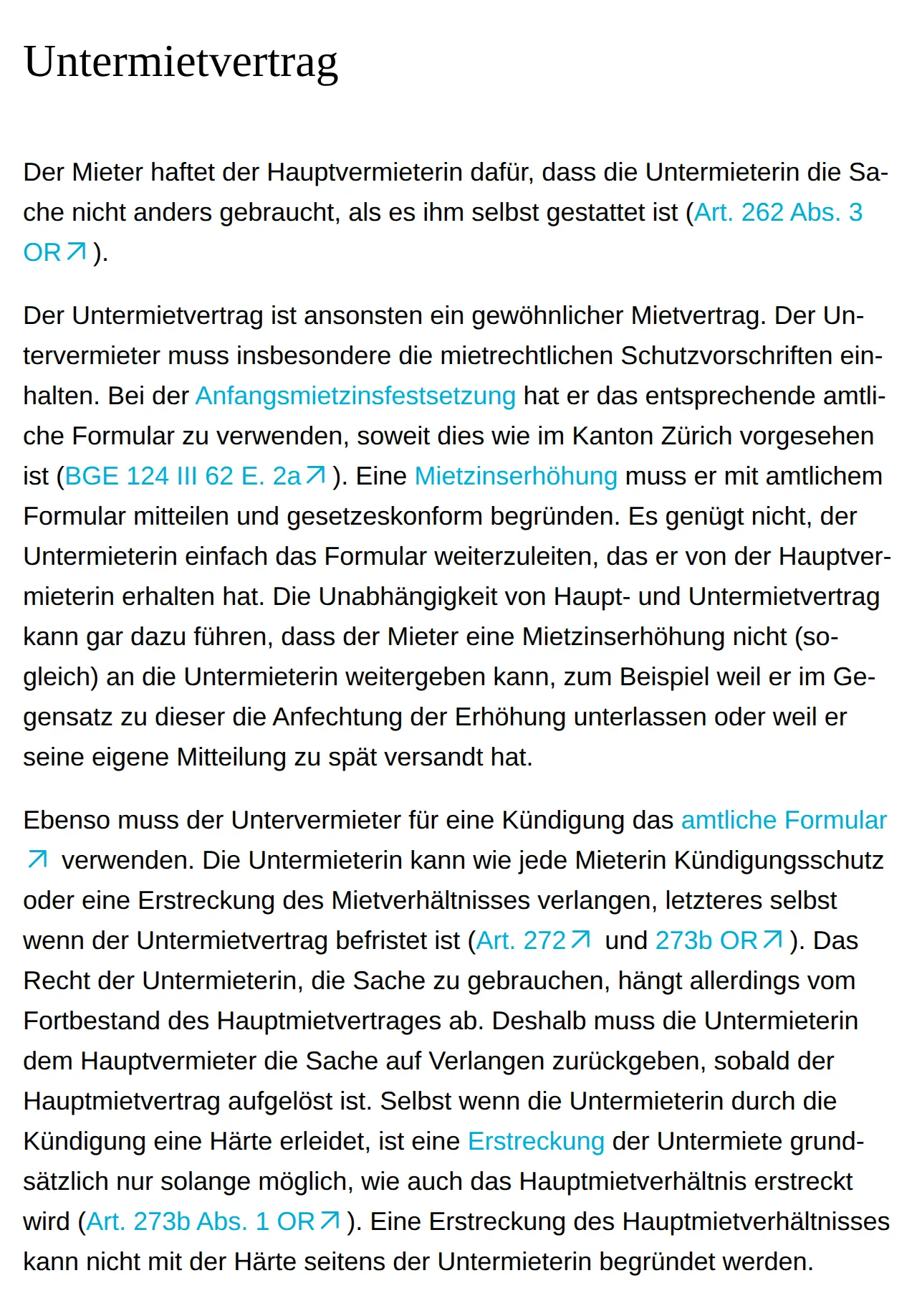
As a subtenant, you have the same rights as any tenant, with one big limitation. The courts state that the person subletting must use the official form for the initial rent and for any notice, and that you can ask for an extension, even with a fixed-term sublease. But your right to the flat depends on the main lease. If it ends, you have to give the flat back, and you only get an extension as long as the main lease is extended too (Art. 273b CO). One exception protects you from tricks: if the main purpose of the sublet is to get around protection against termination, you are protected regardless of the main lease.
So before you say yes, ask to see two things. A short message is enough:
Hello, I like the flat and would be glad to take it from 1 March to 31 August 2027. Before I sign, could you please send me your property manager's written consent to the sublet for this period and a copy of your lease showing the current rent? I'm happy to pay the deposit into a rent deposit account in my name. Kind regards
If someone dodges this, they often have a reason. Shorter notice periods apply to a furnished room, and with a holiday flat rented for a short time, part of your protection as a tenant falls away.
Furnished rooms and holiday flats
Either side can end the lease on a furnished room with two weeks' notice to the end of a one-month rental period (Art. 266e CO), unless the lease provides for something longer. That's flexible for you, but just as flexible for the landlord. According to the tenants' association, a room counts as furnished if the landlord provides at least a bed, a chair, a table and a wardrobe. If you also share the living room, that points more towards a flat share, and then three months' notice applies, as with a flat.
Be careful with offers described as holiday flats. For holiday homes rented for three months or less, the special rules for residential premises don't apply (Art. 253a CO). A lease like that suits a summer in the city, not the start of a new job. If you rent a flat to live in, it belongs in a normal lease. And every offer for a limited time carries another risk too.
Scams with temporary flats
Scammers lure people with rental and holiday flats that don't exist. The Zurich Cantonal Police describe the typical pattern on cybercrimepolice.ch: a lovely flat far below market price, a landlord who is supposedly abroad and can't come to a viewing, then a request for a copy of your ID and a deposit, often through a money transfer service.
One variant sends you to a fake booking site that looks deceptively like a well-known platform. There you're asked to pay the first month's rent as a deposit, and only then would you be allowed to view the flat. The money goes straight to the scammers. The police rule is simple: don't pay a deposit or any advance until you've seen the flat and hold a valid lease. If you've already paid, tell your bank straight away and report it to the police.
How to check a fixed-term offer
Before you sign, answer five questions for yourself. Does the lease end by itself, or does it only have a minimum term? Does it mention a demolition or renovation that rules out an extension? Did you get the form showing the initial rent? Who is your landlord, the owner or another tenant, and is their consent in writing? And where is the deposit held?
Then put two dates in your calendar: the last day to challenge the initial rent, 30 days after you move in, and a date a good 60 days before the end date, when you decide whether to ask for an extension. If you have questions, the conciliation authorities for tenancy matters give legal information on general questions, and the tenants' association has experts who advise on individual cases, for non-members through a hotline at CHF 4.40 a minute.
And keep an eye on the market, even if you've only just moved in. A fixed-term flat buys you time in Zurich. It's most useful if you spend that time looking for something permanent.
Common questions
Do I have to give notice on a fixed-term lease if I move out on the end date?
No. A fixed-term lease ends on the agreed day by itself, without any notice. Still, agree the date and time for handing back the flat early and in writing, so there are no misunderstandings on the last day.
What happens to my fixed-term lease if the building is sold?
The lease passes to the buyer along with the building and carries on. The new owner can only end it early if they urgently need the flat for themselves or close relatives, and then only with the statutory notice period for the next statutory termination date. If this causes you a loss, the previous landlord is liable.
Can a landlord end a fixed-term lease early if I don't pay the rent?
Yes. The landlord must first give you at least 30 days in writing to pay and warn you that the lease will be terminated otherwise. If you still don't pay, they can give at least 30 days' notice to the end of a month, and you can't get an extension in that case.
Does the three-month deposit limit also apply to a sublet?
Yes. A sublease is an ordinary lease, so the main tenant can't ask for more than three months' rent as a deposit either. The money belongs in a bank account in your name, not in cash in someone else's drawer.
Can I take over the flat myself when my sublet ends?
You have no right to it. When the main lease ends, the property manager can let the flat to someone else. It's still worth asking early, as some landlords are happy to take someone who already knows the building.
More from the blog
All posts
Renting in Zurich with debt collection entries (Betreibung)
Renting in Zurich with a Betreibung on your extract: what landlords see, how to get disputed entries hidden under the 2026 rules, and who still rents to you.

Renting with a dog in Zurich: landlord consent and dog tax
Dog or cat in a Zurich rental: when your landlord can say no, what you pay for damage on moving out, plus registration, the CHF 160 dog tax and banned breeds.

Weekly resident in Zurich: registration, tax, housing
Weekly resident in Zurich: registering with the Residents' Registration Office, when Zurich taxes you, 2026 deductions and which home suits you.