Renting in Zurich with debt collection entries (Betreibung)

Before you apply
Yes, you can get a flat in Zurich even with entries in the debt collection register, but it won't happen by itself. Start by sorting the entries. A debt collection you objected to and never paid can be hidden for CHF 40 if the creditor doesn't go to court, and since 2026 that works throughout the whole five years. You explain paid debts openly and lower the landlord's risk with a second person who shares liability.
There is no way around the extract. The City of Zurich asks for an extract no more than six months old from every adult on an application for one of its flats, and according to the association of Zurich housing cooperatives, most cooperatives ask for one too. Most guides on the subject stop at "talk about it openly". We go through the steps that actually change what the extract shows, with the forms of the city's debt collection offices and the rules in force since 1 January 2026. We link the English text of the Debt Enforcement and Bankruptcy Act (DEBA) on Fedlex. The current Code of Obligations is not yet published in English, so those links go to the German text, as do the city, canton, federal office and advice service pages.
What landlords see on your extract
The extract lists every debt collection started against you in the last five years in the district of the issuing office. That is what the standard notice on every extract says, in wording set by the Federal Office of Justice (Directive No. 5, point 17). Suspended proceedings and those the creditor can no longer continue are listed too. On top of that come the number and total amount of unpaid debt certificates (Verlustscheine) from seizures in the last 20 years that are still open. An unpaid debt certificate confirms that a seizure did not cover the debt.
Not listed are debt collections the creditor withdrew, those a court cancelled, and those hidden at your request. That is exactly where the routes further down come in.
One point matters for how an entry is read: a payment order (Zahlungsbefehl) does not prove that you owe anything. If you dispute a claim, you file an objection (Rechtsvorschlag) within ten days, and then the creditor has to prove the claim is justified, as the City of Zurich explains. The debt collection still appears on the extract, with its status.
Twelve districts, twelve registers
In the city of Zurich, each of the twelve city districts is a debt collection district of its own. That is set out in the annex to the cantonal Introductory Act to the DEBA. An extract from District 9 shows nothing from your time in District 4. Since April 2020, however, the Zurich offices have noted on the extract the dates you moved in and out over the last five years (§ 6a). So moving does not make an entry invisible. The standard notice on every extract even advises getting an extract from any other district you lived in before.
The best way to order the extract is the city's online form. It finds the right office itself and covers every address in the city where you lived in the last five years. You upload a photo or scan of your ID. At the counter of the right office you get the extract within minutes and pay in cash or by debit card. The fee is set by the federal government: CHF 17, or CHF 18 if it is sent by post or electronically (Art. 12a GebV SchKG, the federal fee ordinance).
What a landlord may ask
The Federal Data Protection and Information Commissioner has set out where the line lies in its guidance on rental application forms, with the details in a leaflet in German. Letting agencies may ask every applicant for a copy of the extract. They may ask about pending debt collections and about unpaid debt certificates, but only those from the last five years. Questions about wage garnishments, leasing or hire purchase contracts are not allowed. If you don't get the flat, the agency has to destroy your documents once the flat is let.
How long a debt collection stays visible
A debt collection stays on the extract for five years, even if you paid the amount long ago. The city's debt collection offices leave no doubt about that. Paying on its own deletes nothing. Before the five years are up, an entry only disappears if the creditor withdraws it, a court cancels the debt collection, or the office hides it at your request (Art. 8a para. 3 DEBA).
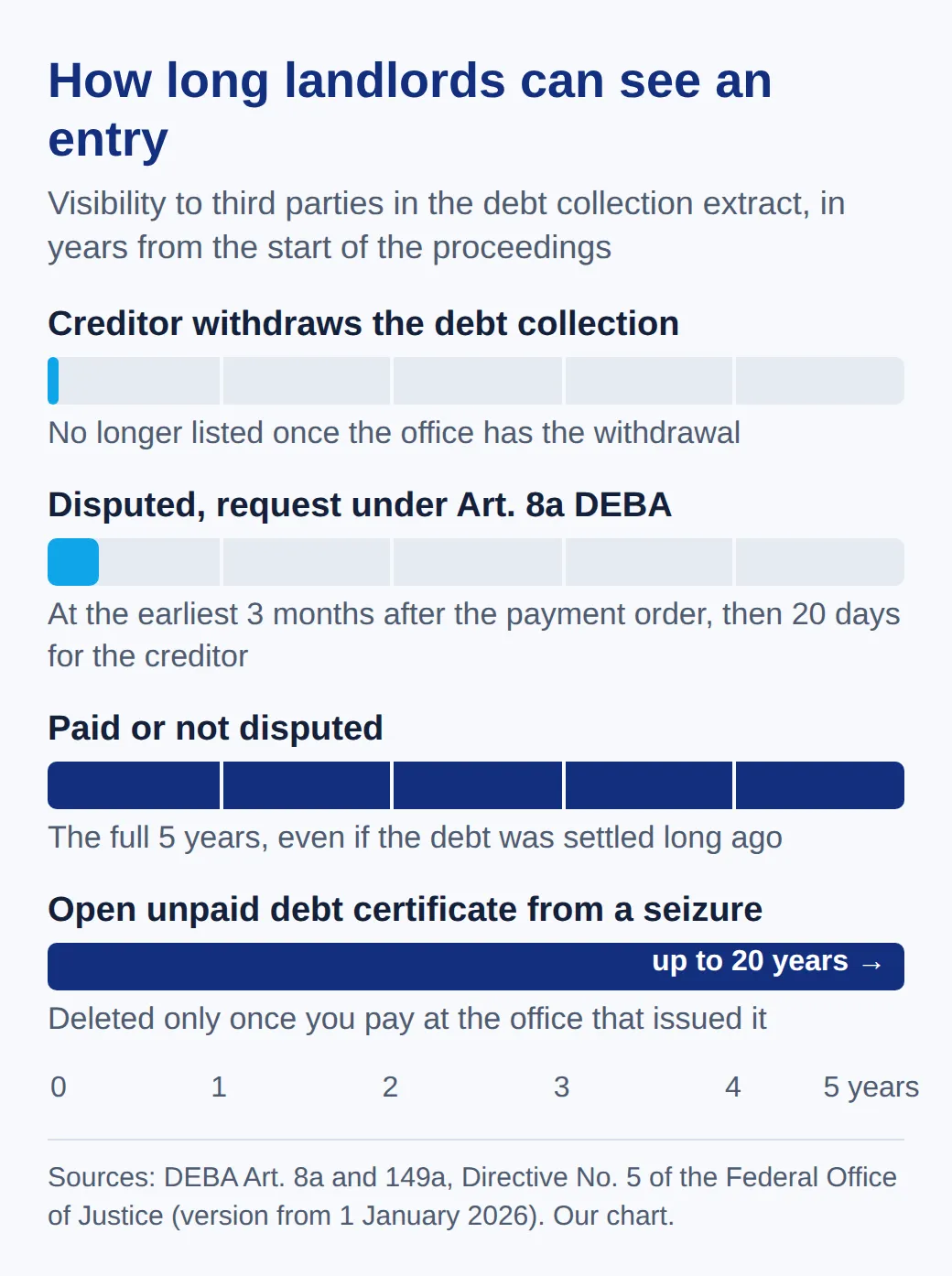
Only the unpaid debt certificate lasts longer. The claim behind it only becomes time-barred 20 years after the certificate was issued, and it counts on the extract for that long. But you can pay it at any time at the office that issued it, and the entry is then deleted (Art. 149a DEBA). Which of these routes fits depends on each individual entry.
Which route fits which entry
Go through your extract line by line and ask two questions about each debt collection: do you really owe the money, and what have you done about it so far?
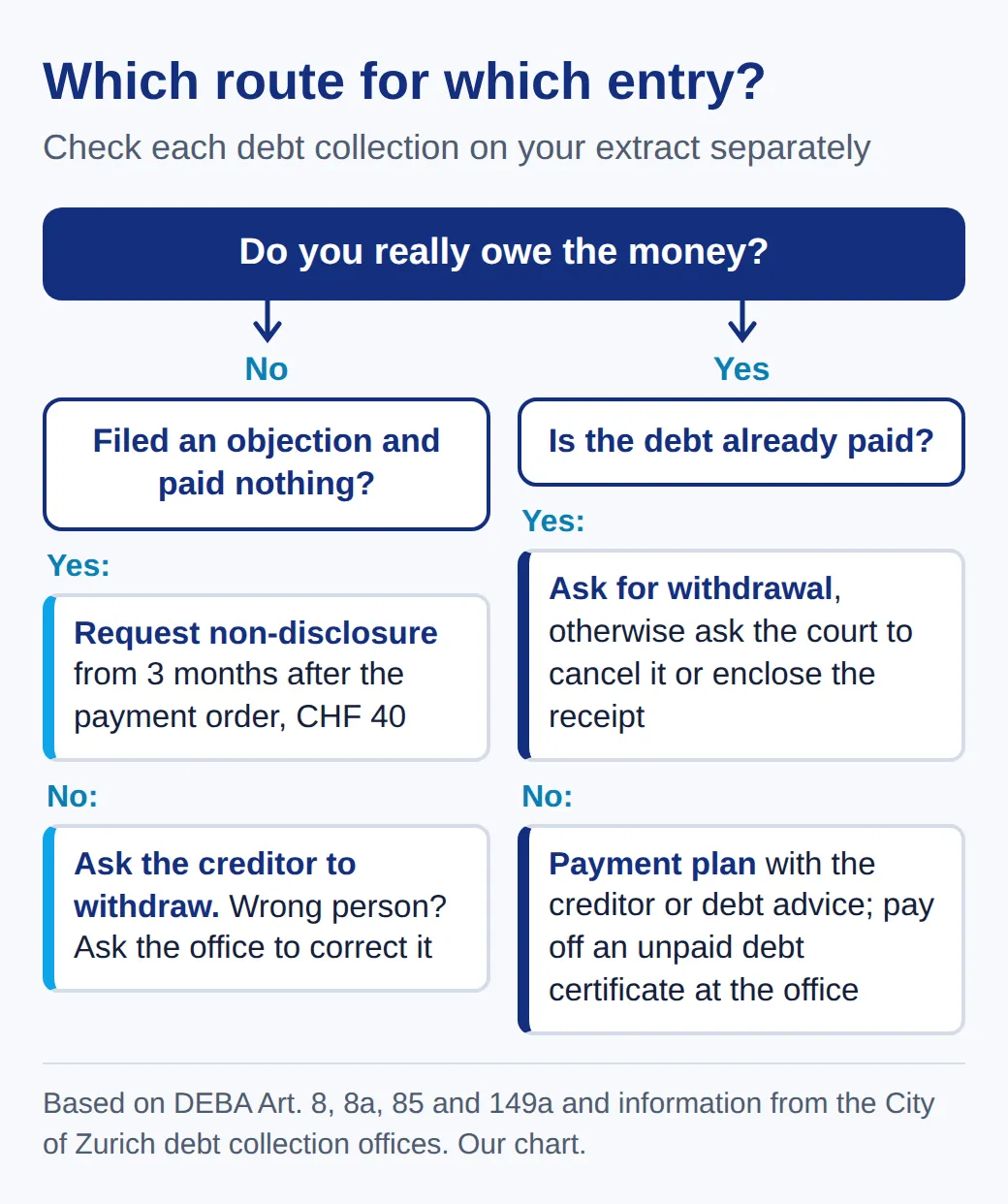
One special case comes first: if a debt collection is simply wrong in the register, for example because you were mixed up with someone of the same name, the office corrects the entry at your request (Art. 8 para. 3 DEBA). For every other disputed claim there has been a procedure of its own since 2019, and it was improved considerably from 2026.
Hiding an unjustified debt collection
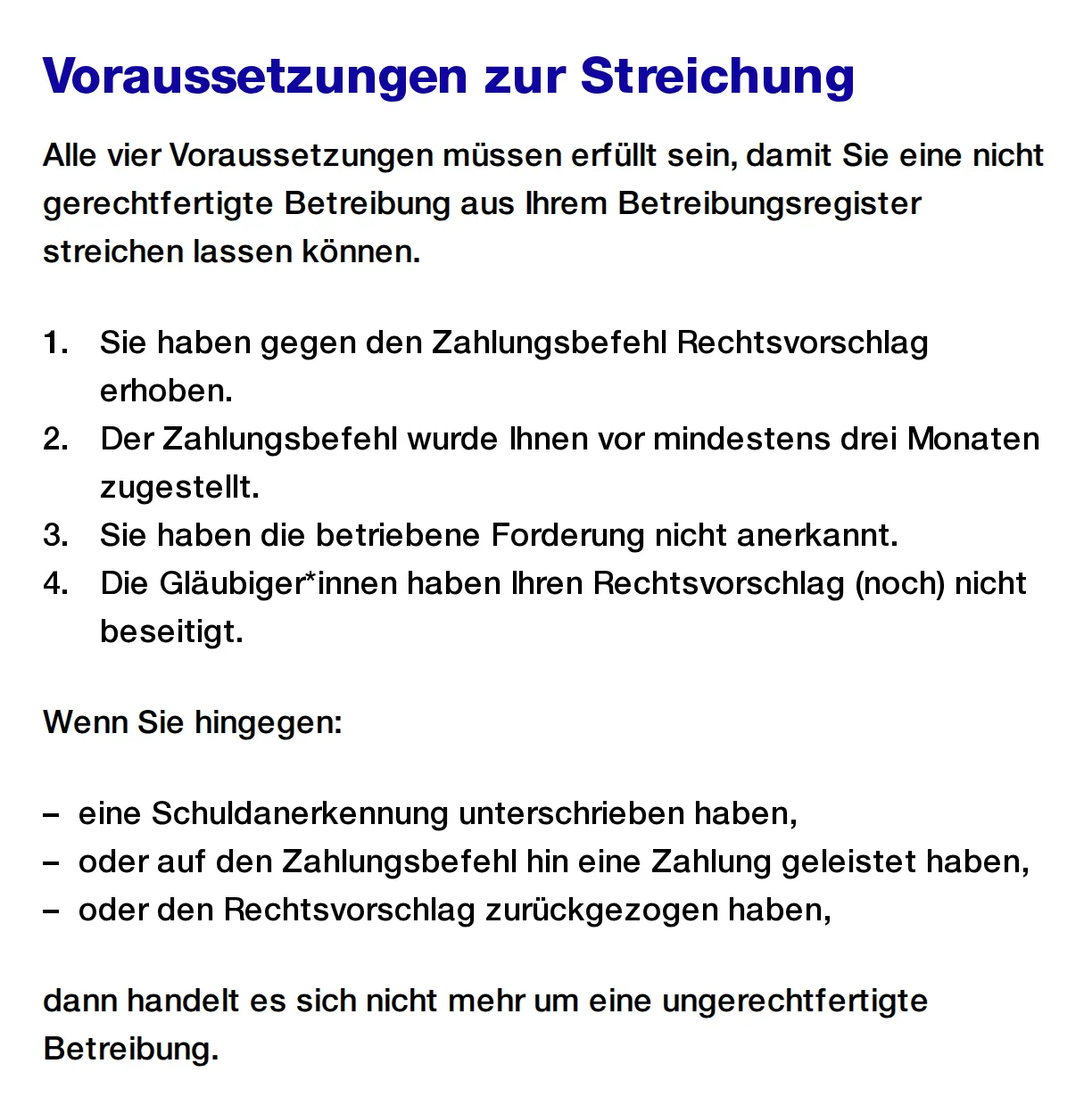
If you filed an objection and paid nothing, you can ask the office to stop showing the debt collection to third parties once three months have passed since the payment order. The creditor then gets 20 days to prove that they have taken action against your objection. If they don't, the entry is hidden.
You send the request to the debt collection office that delivered the payment order to you. The city provides the form Gesuch um Nichtbekanntgabe einer Betreibung (request for non-disclosure of a debt collection). It needs the debt collection number, your details and the creditor's. According to the directive, the form is not compulsory: the office also has to accept a letter or a request made in person, and an office that isn't responsible has to forward it.
With the request you pay CHF 40. This flat fee covers the whole procedure, but it is also due if the request fails (Art. 12b GebV SchKG). The office then sends the creditor an official form asking for proof within 20 days: that they have applied to a court to set aside your objection or have sued for recognition of the claim. If nothing comes, the office makes the debt collection invisible to third parties by the second day after the deadline at the latest, and lets you know. From then on it is also missing from the extract you order about yourself.
| Step | Deadline |
|---|---|
| File an objection | within 10 days of receiving the payment order |
| Submit the request | 3 months after delivery at the earliest |
| Creditor's proof | 20 days from the office's demand, plus postal time |
| Entry hidden | by the 2nd day after the deadline at the latest |
| Last possible date | as long as the debt collection is on the extract |
The deadlines come from Art. 74 and Art. 8a DEBA and from Directive No. 5. A request that arrives more than two days too early can be rejected, and the CHF 40 is then gone. The city's flow chart shows the procedure with all its branches.
What changed in 2026
Until the end of 2025, this procedure came to nothing if you had waited too long. In 2021 the Federal Supreme Court rejected a request because it came more than a year after the debt collection was started (judgment 5A_927/2020). And in BGE 147 III 41 it held that a creditor whose court application to set aside the objection fails can still prevent the entry from being hidden. Parliament corrected both on 21 March 2025, and the Federal Council brought the change into force on 1 January 2026, as the Federal Office of Justice announced.
Since then you can make the request at any point during the five years in which third parties see the debt collection. And if the creditor's proceedings against your objection have failed for good, the request is open to you as well; you have to prove that failure to the office. According to the directive, the new rule applies to every debt collection still on the extract. If you were turned down before because of the one-year limit, you can submit a new request; it costs another CHF 40.
When the request fails
The request requires that you disputed the claim from the start. Without an objection, or with an objection to only part of the amount, the office rejects it straight away. The same applies if the creditor has already started proceedings against your objection or asked for the debt collection to be continued.
The biggest trap is a payment. If you end up paying the claim after receiving the payment order, you lose this route, even with an objection. If the entry is already hidden and you pay afterwards, it becomes visible again according to the directive as soon as the office learns of the payment, now marked as paid (bezahlt). Only if you had paid before the payment order was delivered may you still make the request (Federal Supreme Court, 5A_245/2024). So don't pay a claim you believe is wrong just to get a clean extract. For debts that really were owed, the route goes through the creditor.
Paid debts: asking the creditor to withdraw
Whether a paid debt collection disappears from the extract is not up to the office but up to the creditor. They can withdraw it, but don't have to. According to the city's offices, some creditors are willing to if you have paid the bill and the collection costs or agree a payment arrangement with them. Some charge a fee for it. The creditor reports the withdrawal to the debt collection office on a form, and the office deletes the debt collection.
Keep it short and give the numbers the office needs. A sample, which you would send in German to a German-speaking creditor:
Debt collection no. 2025-12345, invoice no. 88123
Dear Sir or Madam, I paid your claim in full, including the debt collection costs, on 14 May 2026; the confirmation is enclosed. I am currently looking for a flat and ask you to withdraw the debt collection at the Betreibungsamt Zürich 9. You will find the withdrawal form on the City of Zurich website under «Betreibung löschen». Thank you, and kind regards
If the creditor won't budge, the law provides a route through the courts. If you can prove with documents that the debt, interest and costs have been paid, you can ask the court at the place of debt enforcement to cancel the debt collection at any time (Art. 85 DEBA), and the office no longer shows a debt collection cancelled by a court to third parties. That costs court fees, so get advice first. If neither works, the entry stays until the five years are up, and then your application has to outweigh it.
What outweighs an entry in your application
A landlord wants to know whether the rent will arrive on time in future. An old, paid entry weighs less if you explain it and show that you have paid reliably since. In its flat-hunting guide, Caritas Zürich advises addressing debt collections in your cover letter and, if possible, getting a letter from your current letting agency confirming that you pay the rent regularly.
Add the usual documents the same guide lists: your salary certificate, your last three payslips and your final tax bill, confirmation from Social Services if they support you, and references from your employer, letting agency or social worker. Say who pays the rent. Send a good copy of the extract, not the original, unless the original is asked for. A paragraph in your cover letter could read:
About my debt collection extract: the two entries from 2024 are for health insurance premiums I could not pay after a period without work. Both claims have been paid, and the receipts are enclosed. Since March 2025 I have had a permanent full-time job, and my current letting agency confirms that I have paid the rent on time since.
Specific beats long: dates, amounts, proof. Explain an open debt with a payment plan in progress the same way, with the plan enclosed. If that is not enough, a second signature helps.
Guarantors, joint liability and the rent deposit
A second person who backs your rent lowers the landlord's risk most directly. The City of Zurich expressly provides for this in its application process: if there is joint and several liability or a guarantee, you add the jointly liable person and also upload their debt collection extract and final tax bill. So the second person needs a clean extract themselves.
The two forms differ. With joint and several liability, the second person co-signs the lease and is liable for the whole rent as if it were their own. A guarantee (Bürgschaft) is a separate contract, and the law deliberately makes it hard (Art. 493 CO). It has to be in writing and state a maximum amount in francs. If a private individual guarantees more than CHF 2,000, it has to be publicly certified by a notary; up to CHF 2,000 it is enough for the guarantor to write the amount by hand. Three months' rent on a CHF 1,500 flat is already over that limit. If the guarantor is married, their spouse has to agree in writing beforehand or at the same time (Art. 494 CO).
The rental deposit has a fixed upper limit: for a flat, the landlord may ask for at most three months' rent, and the money goes into an account in your name (Art. 257e CO). So the landlord cannot demand a higher deposit to make up for an entry, and you don't have to offer one. If there is no such person among the people you know, there are organisations in Zurich that take on this role.
Where an entry counts for less
For the City of Zurich's own flats, a random draw decides who gets a viewing. Before that, the city rules out applications where there are «Kriterien, die eine Vermietung verunmöglichen», criteria that make letting impossible; the rental regulations don't say which ones (Art. 32). They don't name debt collections as a reason for exclusion anywhere. Among the criteria for awarding a flat, on the other hand, they expressly list giving consideration to people who are at a disadvantage on the housing market (Art. 25). For social hardship cases, the city can also let flats without advertising them, at the request of Social Services (Art. 23). You still upload the extract, and there it may be up to six months old.
Cooperatives set their own rules in their letting regulations, which most of them put online. They usually ask for an extract as well, and share capital is normally due before you move in. How the big Zurich cooperatives choose their tenants and how much capital they ask for is in our article on cooperative flats in Zurich.
For people who struggle on the open market, there is the Domicil foundation. It expressly also places people with debts, on social assistance or looking for work, as long as they have lived in the city or canton of Zurich for at least two years, are in a precarious housing situation and can manage their daily lives on their own. The foundation names two limits expressly: no open debt collections for unpaid rent, and none over CHF 100,000. Registration costs CHF 60, a successful placement one and a half months' gross rent, and you put up the deposit of three months' gross rent yourself. Be patient: checking your registration takes up to ten weeks, and after that, according to Domicil, you wait about five months for an interview. Domicil is jointly liable under the lease or takes on the lease itself, and supports the tenants afterwards. The foundation does not cover rent arrears; you pay the rent yourself. Caritas Zürich also offers advice and support with the search through its WohnFit programme, and the association of housing cooperatives lists both services in its flat-hunting tips.
What to do now
First order your own extract, online and for all your Zurich addresses of the last five years. Match each entry to one of the routes above. For every disputed debt collection where you paid nothing and the three months are up, submit the request for non-disclosure. A decision takes at least the creditor's 20 days plus postal time. At the same time, write to the creditors of paid claims. For open debts, the Schuldenberatung Kanton Zürich, the canton's debt advice service, can help, including through its free hotline 0800 708 708, open Monday to Thursday from 10 am to 1 pm.
While that runs, put your application together: a note explaining your extract, confirmation from your letting agency, proof of income and, if possible, a person who co-signs as jointly liable. Order a new extract as soon as an entry has been hidden or withdrawn, so that your application shows the clean record. Then apply: to the city, to cooperatives and on the open market.
Common questions
Can a landlord order my debt collection extract without asking me?
Yes. Anyone who can show a credible interest may ask the debt collection office for an extract about another person, and a planned contract expressly counts as such an interest (Art. 8a para. 2 DEBA). Debt collections that were withdrawn or hidden at your request are no more visible to the landlord than they are to you.
Does a debt collection entry disappear if I move within the city of Zurich?
No. Each of the twelve city districts is a debt collection district of its own, and the entry stays in the register of your old district. The extract from your new district shows the date you moved in, though, and its standard notice advises getting an extract from any other district you lived in before. Use the city's online form to order one extract covering all your addresses from the last five years.
How much does a request to hide a debt collection cost if it is refused?
The CHF 40 is due in any case, even if the office rejects the request. But nothing else is added on top: no further fees or expenses. A second request for the same debt collection costs another CHF 40, so really do wait out the three months.
Can a landlord ask about wage garnishments or leasing contracts?
Not according to the guidance of the Federal Data Protection and Information Commissioner. Landlords may ask about pending debt collections and about unpaid debt certificates from the last five years, and may ask for a copy of your debt collection extract. Afterwards they have to destroy the documents of every applicant who did not get the flat.
I'm new to Zurich and have no debt collection extract yet. What do I submit?
Order an extract from your Zurich debt collection office anyway. The Zurich offices note on it the date you moved in, or that you were not registered in the district in the last five years, so the landlord can see why the extract is so short. If you lived in another Swiss municipality before, add the extract from there.
More from the blog
All posts
Renting with a dog in Zurich: landlord consent and dog tax
Dog or cat in a Zurich rental: when your landlord can say no, what you pay for damage on moving out, plus registration, the CHF 160 dog tax and banned breeds.

Challenging the initial rent in Zurich: deadline, form, odds
How to challenge your initial rent in the canton of Zurich: the 30-day deadline, what the form must show, comparable rents and 2025 conciliation results.

Cheaper living near Zurich: rent, ZVV pass and tax 2026
Living near Zurich instead of in the city: what new tenants save on rent, and what the ZVV pass, tax rate and health insurance take back. 2026 figures.