Challenging the initial rent in Zurich: deadline, form, odds

The short answer
In the canton of Zurich, you can challenge your initial rent by sending an application to the conciliation authority of your district within 30 days of getting the keys. Because the canton has a housing shortage, almost every new tenant is allowed to challenge. Whether the rent actually goes down depends on whether it is unfair under the law. The conciliation procedure costs you nothing.
Most guides explain the article of the law and stop there. We read the official Zurich form, which has asked for two extra details since October 2025, analysed the figures of the Zurich conciliation authorities from 2021 to 2025 and went through the Federal Supreme Court's rulings on Zurich cases. That tells you what to check before you apply, how the procedure works and what it realistically brings. We link the English text of the Code of Obligations and the Civil Procedure Code on Fedlex; the ordinance, canton, court and federal office pages we link are in German only.
When can you challenge the initial rent?
You can challenge it if you had to sign because of the situation on the housing market or a personal hardship, or if the landlord raised the rent significantly compared with the previous tenant's. That is what Art. 270 CO says. One of the two conditions is enough.
In Zurich, the first one almost always applies. On 1 June 2026, only 0.52 percent of flats in the canton were vacant, and 0.11 percent in the city (Canton of Zurich). In a Zurich case, the Federal Supreme Court ruled that a housing shortage on the local market is enough (BGE 142 III 442). You don't have to prove a personal emergency or a failed search. The tenants in that case had rented a maisonette in the city in 2013, when the vacancy rate was also 0.11 percent. The second condition, a significant increase, starts at more than 10 percent according to case law.
One misunderstanding holds many new tenants back for no reason: signing the lease does not mean you have accepted the rent. The tenants' association, the Mieterinnen- und Mieterverband, points this out too. If the form was delivered correctly, the rent only counts as accepted once the 30 days have passed without a challenge.
Parliament wanted to raise the bar. A parliamentary initiative from 2016 asked that only tenants who had also signed out of personal or family hardship should be allowed to challenge. The National Council dropped it on 21 March 2025, and a second one on comparable rents on 20 March 2026. The law is unchanged. The first clue to whether your case stands a chance is a sheet of paper you should have received with the keys.
The form: a legal requirement in the canton of Zurich
Anyone letting a flat to a new tenant in the canton of Zurich has to tell you on an official form what the previous tenant paid and what you will pay. This duty has applied since 1 November 2013 and stays in place as long as no more than 1.5 percent of the canton's flats are empty (§ 229b of the Zurich Introductory Act to the Swiss Civil Code). The Directorate of Justice and Home Affairs provides the form. Landlords may also use their own form if the canton has approved it.
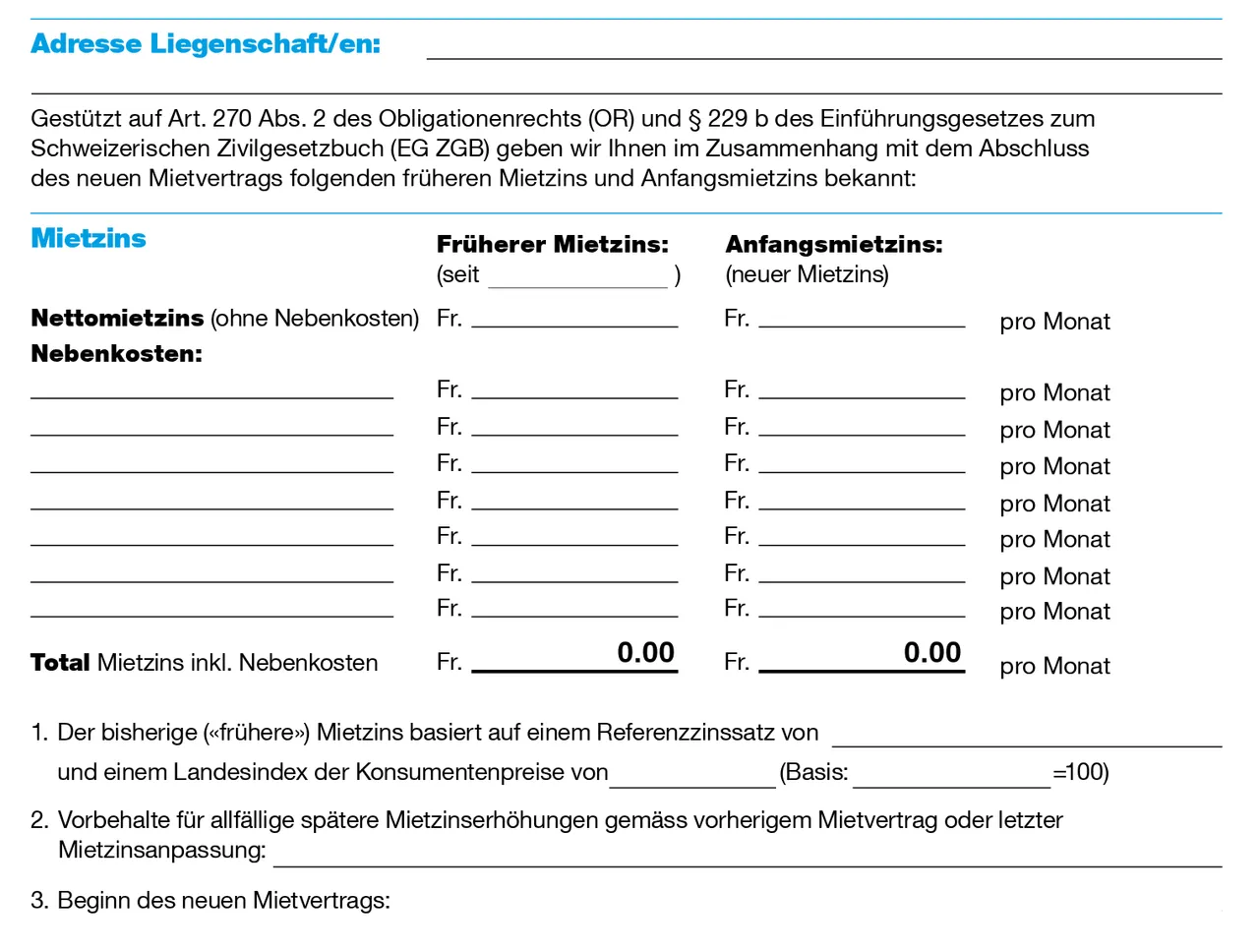
Look closely at four places. First, the previous rent and since when it applied. A rent that has stayed the same for fifteen years explains a bigger jump than one set only last year. Second, the difference: if your net rent is more than 10 percent above the previous one, the second condition is met. Third, point 1: since October 2025, the form has to state the reference interest rate and the level of the Swiss consumer price index on which the previous rent was based (Art. 19 para. 3 VMWG, the federal tenancy ordinance). The reference interest rate has been 1.25 percent since 2 September 2025. If your form shows a higher rate, interest rates point to a lower rent, not a higher one. Fourth, the reason given under point 4 on page 2. In both cases we describe further down, the landlord wrote there that the rent was being brought into line with rents customary in the area and neighbourhood. That is allowed. In a dispute, it is then generally up to you to show that the rent is above what's customary, unless the jump is very large.
No form, a late form or an incomplete one
The form has to reach you when the lease is signed or at the latest when you take over the flat. If it arrives later but still within 30 days of moving in, your deadline only starts when you receive it. If it comes even later, it counts as not delivered (BGE 140 III 583). The same applies if the previous rent is missing, even if you found it out some other way.
The result works in your favour, but it isn't an automatic discount. The lease stays valid; only the agreement on the amount of rent is void. You can then ask a court to set the rent even after the 30 days, and according to the Federal Supreme Court even after the lease has ended, as long as the claim isn't time-barred and you aren't abusing the right. The court sets a reasonable rent, not simply the previous one (BGE 120 II 341). In the tenants' association's view, the agreed rent is also invalid if the form leaves out the reference interest rate or the inflation level, and the 30 days then don't apply. Because these two details have only been required since October 2025, have such a case checked. And if you got no form at all, you can ask the landlord to tell you the previous rent (Art. 256a CO).
The deadline: 30 days from handover of the keys
The 30 days run from when you take possession of the flat, meaning the day you get the keys. Neither the day you sign nor the start date in the lease counts. If you get the keys the day before, the day before counts.
Counting starts the following day (Art. 77 CO). If the last day falls on a Saturday, Sunday or public holiday, the deadline ends on the next working day (Art. 78 CO). An example: keys handed over on Thursday 1 October 2026. Day 30 is Saturday 31 October, so the deadline runs until Monday 2 November 2026.
This deadline can't be extended. The form says so plainly: if there is no challenge, the initial rent counts as accepted. After that, you can only ask for a reduction if the basis changes, for example because the reference interest rate falls (Art. 270a CO). So send your application by registered post a few days before the deadline. Then the question of exactly which day counts never comes up.
Is the rent unfair? Comparable rents and the landlord's return
Being allowed to challenge doesn't mean the rent will fall. It has to be unfair, and the courts judge that by the rent itself, not just by the jump from the previous one. Which yardstick applies depends on the age of the building.
For an older building, what counts most is what's customary in the neighbourhood. A building counts as old if it was built, or bought by its current owner, at least 30 years before the lease began (BGE 144 III 514). It is compared with flats that are similar in location, size, fittings, condition and period of construction (Art. 11 VMWG). The Federal Supreme Court requires at least five such comparable flats, or official statistics that reflect these features. The tenants' association offers a template you can use to ask neighbours about their rent. For a first idea of where your rent sits, see our overview of rents by district. Whether a court accepts such averages as evidence is another matter.
For newer buildings, the return counts. The landlord may earn a return on the equity invested equal to the reference interest rate plus 2 percentage points, as long as that rate is at most 2 percent (BGE 147 III 14). Today that comes to 3.25 percent. Only the landlord has the figures, and they have to cooperate in gathering the evidence. The case behind that ruling shows how much this can be worth: a 4.5-room flat in the district of Nyon, built between 1996 and 1998, for 2,190 francs net. The rental court set the rent at 900 francs, the Federal Supreme Court 1,390 francs after correcting the calculation. That is still 800 francs less a month.
With a large jump, a presumption helps you. If the new rent is well over 10 percent above the old one and that can't be explained by the reference interest rate and inflation, it is presumed to be unfair at first. The landlord then has to raise well-founded doubts. One or two comparable flats aren't enough for that, but three or four together with statistics may be. A previous rent that had stayed in place for 15 to 20 years can also be a strong sign in the landlord's favour. If they succeed, it's back to you to bring the five comparable flats.
A case from Zurich
BGE 147 III 431 shows how long this can take. A tenant moved into a 2-room flat in a building from 1933 on 16 April 2017. The previous tenant had paid 738 francs net; she was to pay 1,060 francs, 44 percent more. The reason given on the form: "Anpassung an die orts- und quartierüblichen Verhältnisse", bringing the rent into line with the area and neighbourhood. She filed her application on 2 May 2017, the conciliation authority issued a proposed judgment, and the landlord rejected it and went to court. There she produced 23 comparable flats and a private expert report.
The Zurich rental court (Mietgericht) set the rent at 855 francs, backdated, in August 2019, and the cantonal High Court confirmed this in March 2020, almost three years after the tenant moved in. The Federal Supreme Court overturned that ruling and sent the case back. The presumption applied, clearly so at 44 percent, but the landlord only had to raise well-founded doubts, not furnish full proof. Even then, nothing was final. That is why it's worth looking at how most cases actually end.
Chances of success: what the conciliation figures show
Around nine in ten Zurich initial rent cases whose outcome the statistics record end in an agreement at the conciliation authority. How much the rent falls in the process isn't in the statistics. The figures come from the statistics on conciliation proceedings of the Federal Office for Housing, which every authority reports twice a year.
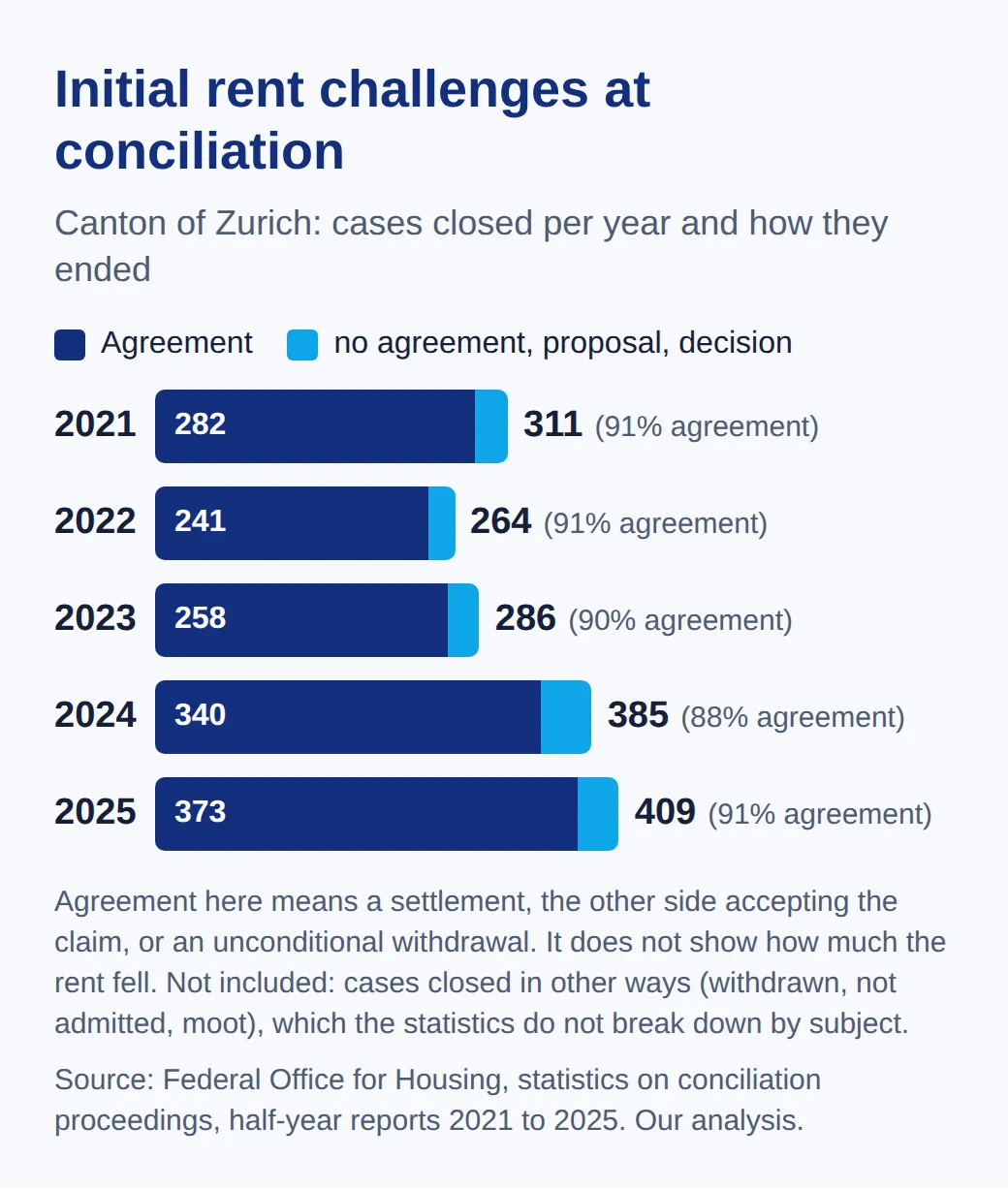
In 2025, the Zurich authorities closed 409 such cases, more than in any of the four years before. That is about 30 percent of all such cases in Switzerland. According to the federal office, most of them come from the cantons of Geneva, Vaud and Zurich. 373 cases ended in an agreement, 35 without one. The Zurich authorities issued a proposed judgment on the initial rent only once in 2025, and it was rejected.
Don't read the 91 percent as a success rate. An agreement can be a settlement, the landlord accepting your claim or you withdrawing your application. The tenants' association describes the practice as the parties often agreeing at the hearing without working out the rent precisely. Your hand is strong with a large jump without renovation, with gaps on the form, and with a newer building with a high rent, where the return counts. It gets harder with a very old, low previous rent or if the landlord has renovated extensively, because added services or improvements justify a higher rent (Art. 269a CO).
How the procedure at the conciliation authority works
The body in charge is the joint conciliation authority at the district court of the district where the flat is, so for the city of Zurich it sits at the Zurich District Court. The justice of the peace (Friedensrichter) has no say in tenancy disputes. The Zurich courts show which authority covers your municipality.
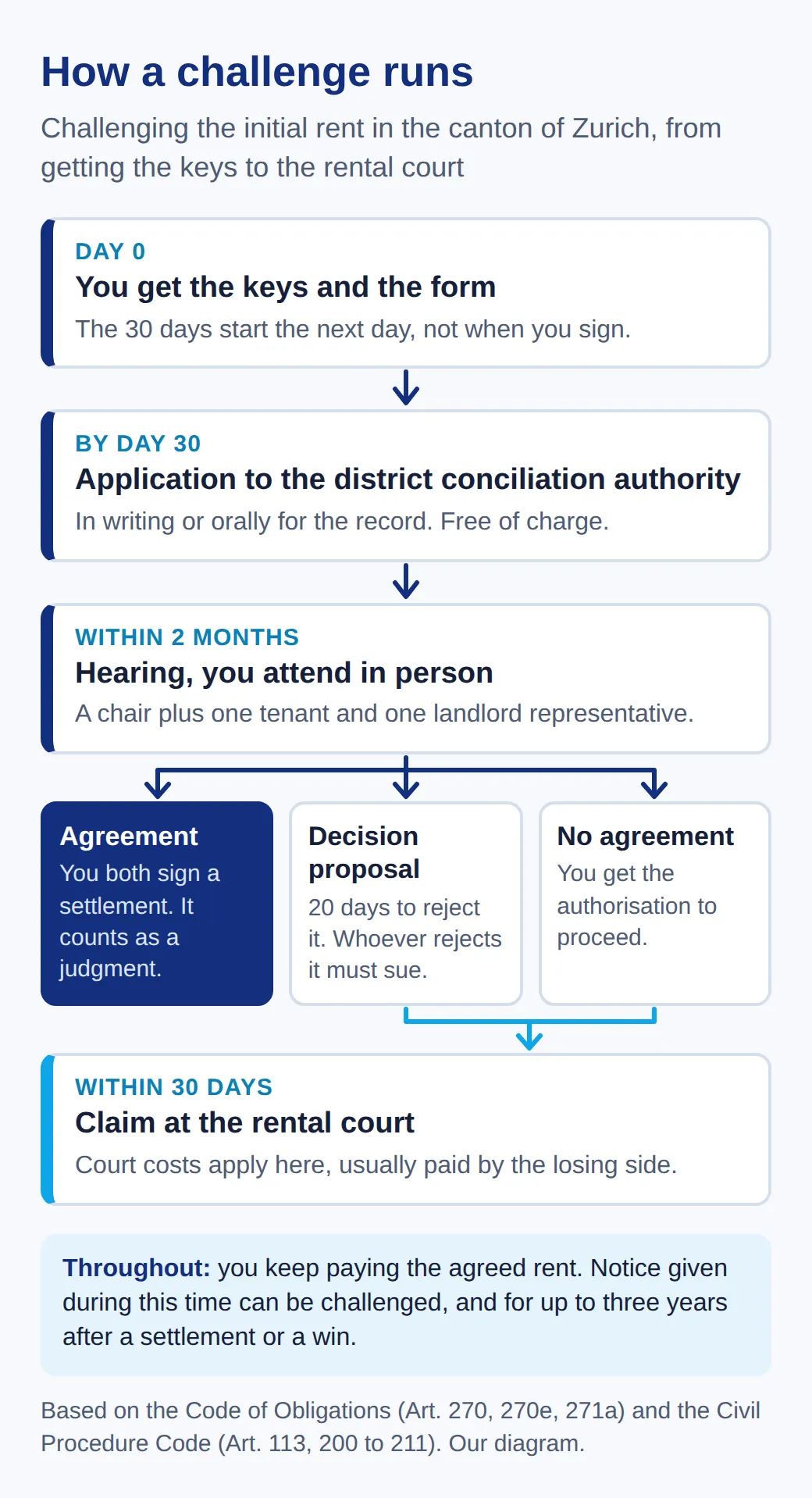
You can file the application in writing or give it orally for the record at the authority (Art. 202 CPC). The easiest way is the Zurich courts' online form: you fill it in over nine steps, get a PDF, sign it and send it off. You need both parties' names, what you're asking for and what the dispute is about. Enclose the lease and the form. Proceedings take place in the canton's official language (Art. 129 CPC), which in Zurich is German, so write your application in German. A simple application can look like this:
Ich fechte den Anfangsmietzins für die 3-Zimmer-Wohnung an der [Adresse], 2. Stock, als missbräuchlich an (Art. 270 OR). Mietbeginn und Schlüsselübergabe: [Datum]. Gemäss amtlichem Formular betrug die Vormiete netto Fr. [Betrag], die neue Miete beträgt Fr. [Betrag]. Ich beantrage, den Nettomietzins ab Mietbeginn auf Fr. [Betrag] herabzusetzen, die Kaution entsprechend zu reduzieren und mir die zu viel bezahlte Miete zurückzuerstatten. Beilagen: Mietvertrag, Formular Anfangsmietzins.
In English, that reads: I challenge the initial rent for the 3-room flat at [address], 2nd floor, as unfair (Art. 270 CO). Start of lease and handover of keys: [date]. According to the official form, the previous net rent was CHF [amount], and the new rent is CHF [amount]. I ask for the net rent to be reduced to CHF [amount] from the start of the lease, for the deposit to be reduced accordingly and for the overpaid rent to be refunded. Enclosed: lease, initial rent form.
The hearing has to take place within two months (Art. 203 CPC). At the table sit a chair and one representative each from the tenants' and landlords' side. You have to attend in person and may bring someone you trust. The landlord may send their property manager if the manager is authorised in writing to agree a settlement (Art. 204 CPC). There are no court costs, and neither side has to pay the other's costs (Art. 113 CPC).
After that, there are three ways it can go. If you agree, you both sign a settlement, which has the same effect as a judgment. Ask for time to think it over if you're unsure. If the authority issues a proposed judgment, each side has 20 days to reject it. Whoever rejects it gets the authorisation to proceed and has to sue within 30 days, or the proposal takes effect (Art. 211 CPC). If there's no agreement, you get the authorisation to proceed and have 30 days to file a claim at the rental court (Art. 209 CPC). Costs do apply there, usually paid by the side that loses.
Neutral advice helps before you apply. The tenancy law advice service at the Zurich District Court is there for tenants and landlords in the city: on Wednesdays from 9 to 11.30 am without an appointment at Wengistrasse 30, and by phone on Mondays and Wednesdays. It advises in German only, and only while no case is under way. The tenants' association gives advice on individual cases, for non-members through a hotline at CHF 4.40 a minute.
During the procedure: rent, deposit, notice
Keep paying the agreed rent until the procedure is over. The lease remains in force unchanged during conciliation and court proceedings (Art. 270e CO). If you pay less on your own initiative, you fall into arrears, and arrears are grounds for termination (Art. 257d CO).
If you win, you get the money back. In the Zurich case above, the rental court set the rent backdated to the start of the lease. In the case from the district of Nyon, the court of first instance ordered the overpaid rent to be paid back and cut the deposit to 2,700 francs.
Many people hold back for fear of being given notice. The law protects you explicitly here. Notice given during conciliation or court proceedings can be challenged, and so can notice given within three years afterwards if the landlord largely lost, reached a settlement with you or withdrew the claim (Art. 271a CO). There are exceptions, for example if the landlord urgently needs the flat for their own use, if you are behind with the rent or if the property is sold. You must challenge such a notice at the conciliation authority within 30 days of receiving it (Art. 273 CO). The tenants' association writes that notice given because of a challenge hardly ever happens in practice.
Before you sign, and after
If you're still looking, ask about the previous rent at the viewing. You have a right to know it from the moment you sign anyway, but knowing earlier what you're getting into makes the later decision easier. The same goes for fixed-term leases, whose rules we explain in our post on fixed-term flats and sublets.
If you already have the keys, go about it in this order. On the day of the handover, put the last day of the deadline in your calendar. Compare the previous rent, date, reference interest rate and reason on the form with your new rent. Ask two or three neighbours in similar flats what they pay, and find out when the building was built or last sold. Then call the advice service or the tenants' association. And file the application as soon as you've decided, not on day 30. You can still withdraw it later; a missed deadline can't be made up.
Common questions
Can I challenge the initial rent on a sublet or a fixed-term lease?
Yes. According to the tenants' association, the same rules apply to a sublet: you bring the challenge against the person subletting to you, also within 30 days. A fixed-term lease is a new lease too, so the form requirement and the right to challenge apply.
Do I need a lawyer for the conciliation hearing?
No. The procedure is informal, and in tenancy matters the conciliation authority is required by law to give the parties legal advice. You can bring someone you trust. Having a professional represent you makes more sense if the case later goes to the rental court.
Can I still claim back overpaid rent after I have moved out?
Only if the form was missing or came too late. In that case the agreement on the rent is void, and the Federal Supreme Court has held that you can ask a court to set the rent even after the lease has ended. The limits are the statute of limitations and the ban on abusing a right. If you received the form in time and let the 30 days pass, the rent counts as accepted.
Does my rental deposit go down if the rent is reduced?
You can ask for that in the same proceedings. In the case from the district of Nyon decided by the Federal Supreme Court, the court of first instance reduced the deposit together with the rent and ordered the overpaid rent to be paid back. So name the lower deposit in your application straight away.
More from the blog
All posts
Renting in Zurich with debt collection entries (Betreibung)
Renting in Zurich with a Betreibung on your extract: what landlords see, how to get disputed entries hidden under the 2026 rules, and who still rents to you.

Renting with a dog in Zurich: landlord consent and dog tax
Dog or cat in a Zurich rental: when your landlord can say no, what you pay for damage on moving out, plus registration, the CHF 160 dog tax and banned breeds.

Cheaper living near Zurich: rent, ZVV pass and tax 2026
Living near Zurich instead of in the city: what new tenants save on rent, and what the ZVV pass, tax rate and health insurance take back. 2026 figures.