Zurich rent prices by district and room size, 2026

At a glance
A 3-room flat from a private landlord in the city of Zurich costs a median of CHF 1,950 a month in net rent. Kreis 1 is the most expensive district at CHF 2,855, Kreis 12 the cheapest at CHF 1,576. That is what the city's rent survey shows for 1 April 2026. If you are signing a new lease, though, you will usually pay more than these figures suggest.
Many overviews of Zurich's districts work from listings. Those are asking prices, often with no word on whether ancillary costs are included and no distinction between a cooperative and a private landlord. We used the data from the city's statistics office, Statistik Stadt Zürich, instead: all twelve districts (each called a Kreis and known by its number), 2, 3 and 4 rooms, net and gross, with private and non-profit landlords kept apart. And we show you how to get from these figures to the price of a flat that is on the market.
What a flat costs in each district
For private landlords, the median net rent ranges from CHF 1,415 for 2 rooms in Kreis 12 to CHF 3,489 for 4 rooms in Kreis 1. "Private" here means every flat that is not let on a non-profit basis, so not by the city, a cooperative or a foundation at cost rent. Net means without ancillary costs (Nebenkosten), the extras such as heating. The median is the middle value: half of the flats cost more, the other half less.
| District | 2 rooms | 3 rooms | 4 rooms |
|---|---|---|---|
| Kreis 1 | 2,194 | 2,855 | 3,489 |
| Kreis 2 | 1,770 | 2,272 | 2,693 |
| Kreis 3 | 1,636 | 1,883 | 2,517 |
| Kreis 4 | 1,784 | 1,986 | 2,584 |
| Kreis 5 | 1,800 | 2,378 | 2,598 |
| Kreis 6 | 1,864 | 2,120 | 2,874 |
| Kreis 7 | 1,800 | 2,230 | 2,606 |
| Kreis 8 | 2,083 | 2,400 | 3,091 |
| Kreis 9 | 1,660 | 1,953 | 2,400 |
| Kreis 10 | 1,589 | 1,804 | 2,081 |
| Kreis 11 | 1,545 | 1,801 | 2,117 |
| Kreis 12 | 1,415 | 1,576 | 1,872 |
| Whole city | 1,670 | 1,950 | 2,434 |
The figures come from the rent survey dataset on the city's open data portal (in German), net rents in Swiss francs per month, as of April 2026. The statistics office has run the survey every two years since 2022 and presented the 2026 results at the end of September 2026 in a report (in German). The base is broad: of 162,498 flats, the city knows the rent of just over 48,000, roughly three in ten. Cooperatives and property managers supply almost 42,000 rents on a regular basis, and a random sample of 9,000 flats brought in another 6,532.
Before you do any sums with these numbers, keep two things in mind. The survey counts every existing lease, including ones that are twenty years old. And every figure is an estimate. For the whole city the margin is narrow: for 3 rooms, CHF 1,920 to 1,979. In Kreis 8 it runs from CHF 2,217 to 2,564. So two districts that sit close together often don't differ at all. The gaps at the two ends of the table, on the other hand, are real.
The most expensive and cheapest districts in Zurich
You pay most in the old town and by the lake, least in the north of the city. Kreis 1 leads for every room count, followed by Kreis 8 with Seefeld and Mühlebach. At the other end are Schwamendingen in Kreis 12, Kreis 11 with Oerlikon, Seebach and Affoltern, and Kreis 10 with Höngg and Wipkingen. For a 3-room flat, the gap between Kreis 8 and Kreis 11 is almost CHF 600 a month, around CHF 7,200 a year.
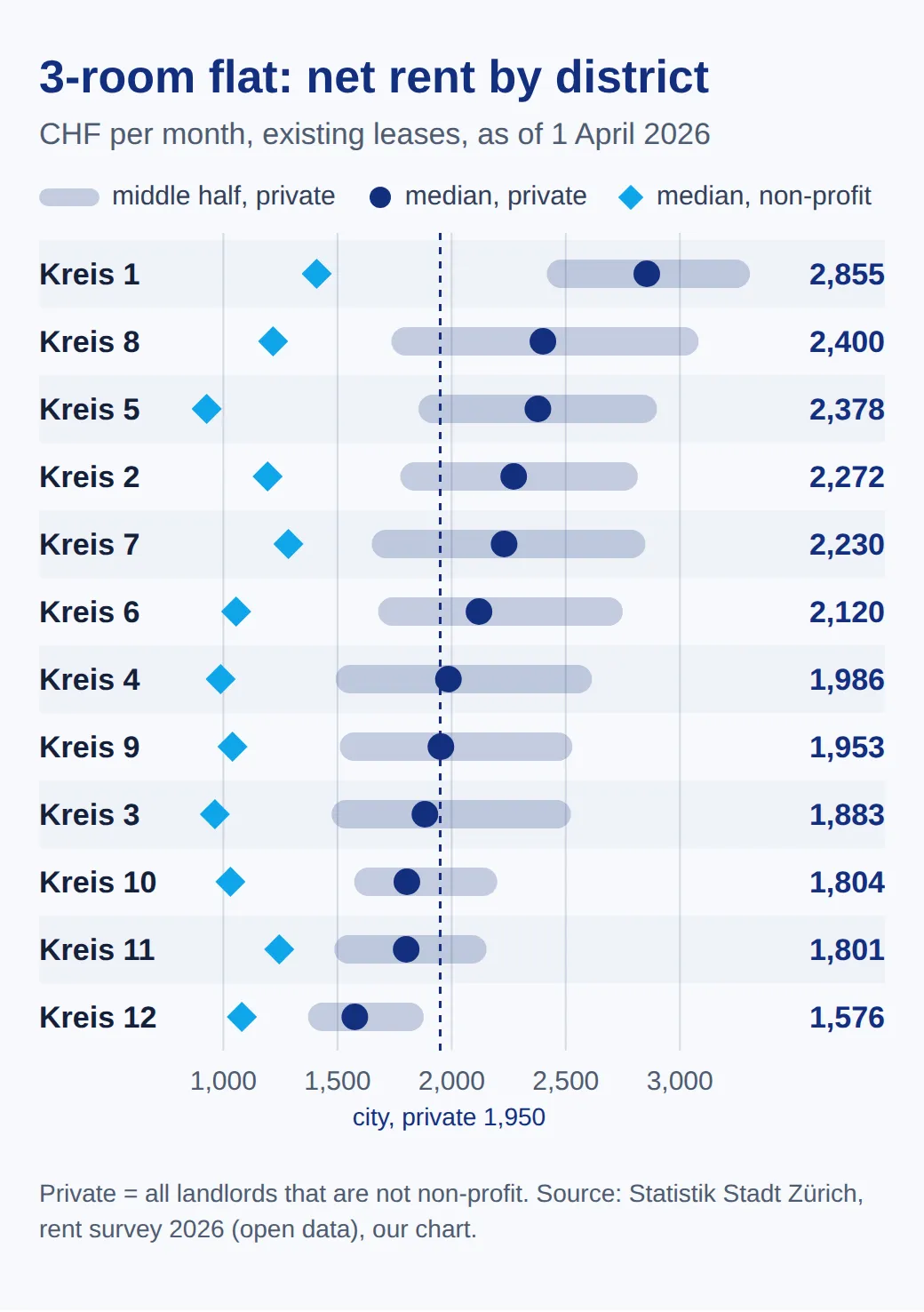
The chart shows something else too: rents within a single district vary widely. The light bars cover the middle half of the flats, leaving out the cheapest 25% and the most expensive 25%. In Kreis 8, that middle half runs from CHF 1,736 to 3,082 for 3 rooms. So a quarter of the private 3-room flats by the lake cost less than the median for the whole city. In Kreis 12, by contrast, the range is narrow, from CHF 1,371 to 1,878. There, even the rent at which the most expensive 25% begin is below the city median.
The order of the districts also depends on the number of rooms. Kreis 5, the Industriequartier, comes third for 3 rooms at CHF 2,378 but only sixth for 4 rooms. Kreis 6 has the third-highest rent for 4 rooms at CHF 2,874, yet only ranks sixth for 3 rooms. Kreis 3, which is Wiedikon, sits slightly below the city median for 2 and 3 rooms, which makes it something like the typical Zurich district. Even that hides differences, though, because several districts are made up of quite different neighbourhoods.
Within a district: the neighbourhoods
In Zurich, a district is not always one place. Kreis 1, 3, 4, 5, 8 and 12 each match a single city quarter: Altstadt, Wiedikon, Aussersihl, Industriequartier, Riesbach and Schwamendingen. The statistics split the other six districts into their former municipalities, and that is where it pays to look closely. The median net rent of a private 3-room flat:
- Kreis 2: Enge CHF 2,551, Wollishofen 2,114, Leimbach 1,768
- Kreis 6: Oberstrass CHF 2,424, Unterstrass 2,026
- Kreis 7: Fluntern CHF 2,847, Hottingen 2,540, Hirslanden 2,066, Witikon 1,898
- Kreis 9: Albisrieden CHF 1,975, Altstetten 1,911
- Kreis 10: Wipkingen CHF 1,902, Höngg 1,791
- Kreis 11: Oerlikon CHF 1,930, Seebach 1,792, Affoltern 1,664
Kreis 7 shows the difference most clearly. Fluntern on the Zürichberg costs almost as much as the old town, while Witikon on the edge of the city sits below the median for the whole city, in the same district. In Kreis 2, almost CHF 800 separate Enge and Leimbach. So if you tick "Kreis 7" or "Kreis 2" in a search filter, you lump together very different price levels. The estimates for the neighbourhoods are less certain than those for the districts, though. For Leimbach, which has only a few privately rented flats, the margin for 3 rooms runs from CHF 1,590 to 2,008.
The city breaks things down further into 34 statistical quarters, but only gives a price per square metre there for all 2- to 4-room flats together. For private landlords, the most expensive are Lindenhof at CHF 40.41 per square metre per month, Rathaus at 37.96 and Seefeld at 34.77. The cheapest are Affoltern at 21.47, Schwamendingen-Mitte at 22.14 and Leimbach at 22.75. The price per square metre is also the best number for judging a single listing.
Comparing a listing per square metre
Flats with the same number of rooms vary in size, so the fairest comparison is per square metre. Divide the net rent by the floor area. Across the whole city, the median for private landlords is CHF 26.50 per square metre per month. By district it ranges from CHF 23.16 in Kreis 12 and 23.76 in Kreis 11 to 32.42 in Kreis 8 and 37.76 in Kreis 1. In between are Kreis 10 at 24.75, Kreis 9 at 25.88, Kreis 3 at 26.51, Kreis 2, 7 and 5 at 28.07 to 28.77, and Kreis 4 and 6 at 29.36 and 29.84.
Here is a worked example with an invented listing: a 3-room flat in Wipkingen, 72 square metres, CHF 2,350 net. That comes to CHF 32.64 per square metre. Existing leases for 3 rooms in Wipkingen have a median of CHF 26.02, so the listing is just over 25% above it. That alone doesn't mean the flat is overpriced. A new lease usually costs more than the median of all existing ones, and the survey shows how much more. First, though, it is worth looking at the second difference between the statistics and a listing: service charges.
Net and gross: what ancillary costs add
According to the city, rents in Zurich are 10 to 15% higher once ancillary costs are included. The gross rent is the net rent plus the monthly payment for ancillary costs such as heating, waste water or the caretaker. Check which of the two amounts a listing gives, and always compare net with net.
The figures in that passage are lower than in our table because the city counts private and non-profit flats together there. For your search, the private figure is the more useful one, since non-profit flats are hard to get. The city also publishes the gross medians in the dataset. For a private 3-room flat, the gross median for the whole city is CHF 2,170, CHF 220 above the net median. By district, that gap ranges from CHF 161 in Kreis 1 to CHF 288 in Kreis 8. Treat it as a guide, not as the ancillary cost statement for a particular flat, because the difference between two medians is not the same as the median ancillary costs. What you actually pay is in the lease. That leaves the bigger mark-up: the one for new leases.
Why advertised rents are higher than these figures
The survey measures what tenants pay, including those who have lived in the same flat for decades. A listing, by contrast, is always a new lease. And new leases cost markedly more. For private landlords, the median for a new tenancy, meaning a lease at most two years old in an older building, is CHF 2,250 for 3 rooms. That is 15% more than the median of all leases. A flat in a new build costs as much as CHF 3,183.
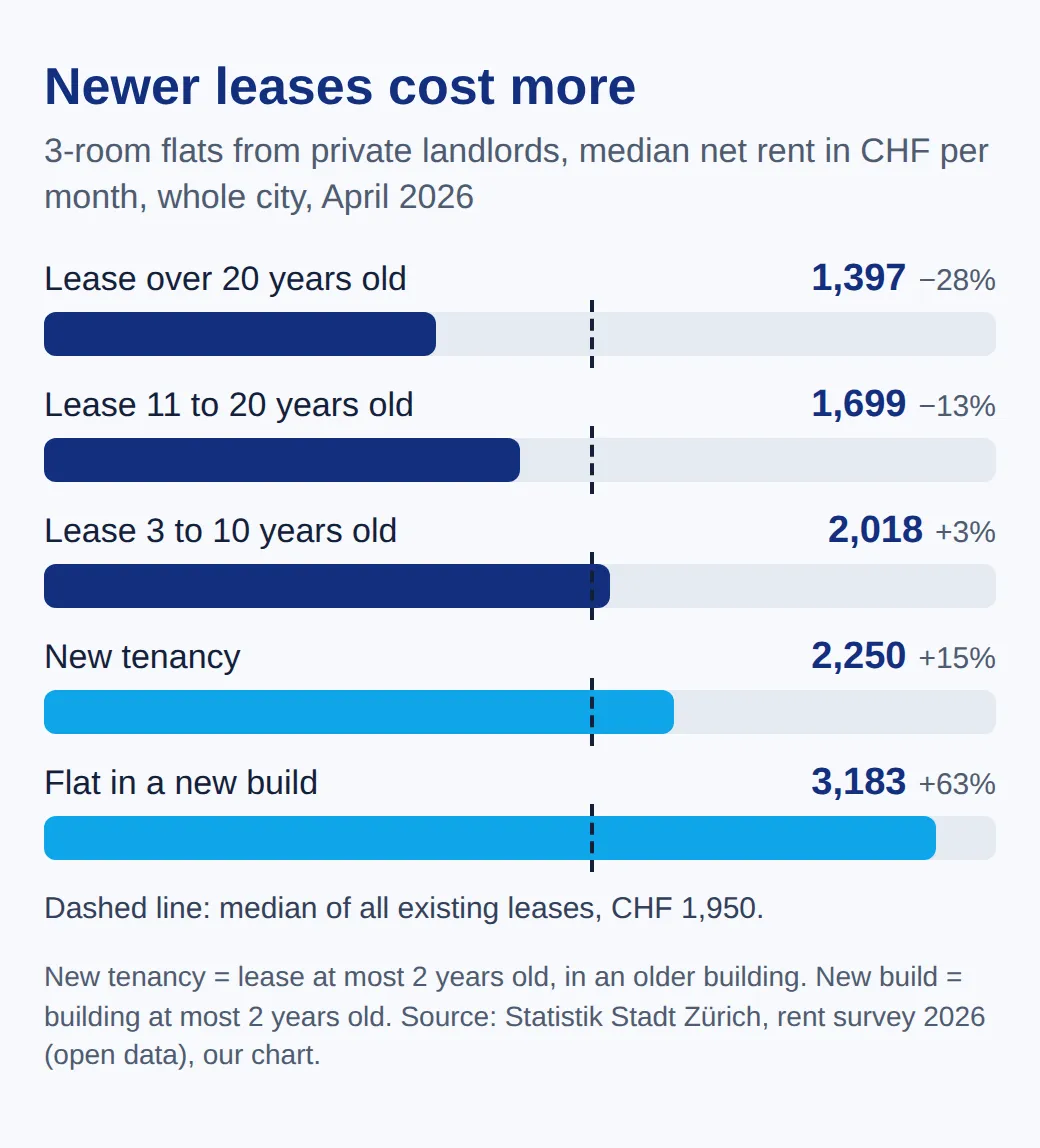
For 2 rooms, a new tenancy is 10% above the median of all leases, for 4 rooms 11%, and for 3 rooms, as mentioned, 15%. Per square metre it is 15% across all three sizes, CHF 30.49 instead of 26.50. The city does not break down the age of leases by district. As a rough rule of thumb, though, you can add 10 to 15% to the figure in our table to estimate what a new lease in an older building costs. That is our own calculation, not an official figure. For a 3-room flat in Kreis 10, it gives around CHF 1,985 to 2,075 instead of 1,804.
Back to the example from Wipkingen: CHF 26.02 plus 15% comes to about CHF 29.90 per square metre, so around CHF 2,150 for 72 square metres. The listing at CHF 2,350 is still about CHF 200 above what a new lease in the neighbourhood typically costs. If the building has just been renovated or is a new build, the price can still be in line with the market.
The gap between new and old leases widened between the last two surveys. From 2024 to 2026, rents per square metre rose by 11% in private new builds and by 7.5% for new tenancies, but only by 3.7% for leases between 3 and 10 years old. Those years also saw the reference interest rate for tenancies go up and down: it was raised twice between 2022 and 2024 and cut twice by 2026. The picture for non-profit flats is quite different.
Non-profit flats: different numbers, different access
Rented from the city, a cooperative or a foundation, a 3-room flat has a median net rent of CHF 1,066, just over CHF 880 less than from a private landlord. By district, the median ranges from CHF 927 in Kreis 5 to CHF 1,409 in Kreis 1. For a typical flat of 75 square metres, the city puts the difference at CHF 838 a month: CHF 1,149 with non-profit landlords, CHF 1,987 with all others.
Location matters less for non-profit flats than for private ones. What counts more is whether the building is new: a non-profit new build costs a median of CHF 1,598 for 3 rooms, a lease more than 20 years old CHF 990. The catch is access. How you can still get one of these flats is covered in our post on finding a cooperative flat in Zurich. For most people looking for a flat right now, that leaves the private market, and prices there have kept rising.
How much rents have gone up
Per square metre, rents in the city of Zurich rose by 3.1% from 2024 to 2026, private and non-profit together. Inflation in the city over the same period was 1.2%. Between 2022 and 2024, rents had risen by 6.5%. For private landlords alone, our analysis of the open data shows the median going from CHF 25.53 to 26.50 per square metre, an increase of 3.8%. Since the first survey in 2022, rents from private landlords have risen by 12.4%.
The differences in the increase between districts are mostly smaller than the uncertainty of the estimates. The price per square metre from private landlords rose most in Kreis 6, from CHF 27.81 to 29.84, or 7.3%. Most of that comes from Oberstrass, the only neighbourhood the city singles out for a somewhat higher increase. The only one it singles out for a rather low increase is Affoltern. Kreis 8 rose least, by 1.8%, though from the second-highest level in the city.
Given the state of the market, it is no surprise that prices keep rising. On 1 June 2026, 252 flats stood empty (in German) across the whole city, 0.11% of the housing stock. In the canton as a whole the rate was 0.52%. Because that is below 1.5%, the canton of Zurich makes an official form compulsory, according to the list kept by the Federal Office for Housing (in German): when signing a new lease, landlords must use the official form for the initial rent. Keep it somewhere safe. If you think the initial rent is unfair, you can challenge it before the conciliation authority within 30 days of moving in (Art. 270 CO).
What the figures mean for your search
This is how to turn the statistics into a realistic budget. Take the figure for your district and room count from the table. Add 10 to 15% for a new lease, and considerably more for a new build. Then add another 10 to 15% for the gross rent. For a 3-room flat in Kreis 9, that takes you from CHF 1,953 net to about CHF 2,150 to 2,250 for a new lease, and to around CHF 2,350 to 2,600 gross.
You save the most if you are flexible about the district. For 3 rooms, almost CHF 600 a month separate Kreis 8 and Kreis 11, and nearly CHF 1,200 separate Fluntern and Affoltern. For every listing, check the price per square metre and set it against the figure for the neighbourhood. If it is more than 15% higher, ask why: a renovation, a new build, a lake view or simply a high price. And plan with the gross rent, because that is what you pay every month.
Common questions
Are there rent figures for studios or 5-room flats in Zurich?
No. The city's rent survey only covers 2-, 3- and 4-room flats, which together make up over 80 percent of rented homes. According to the statistics office, reliable figures per district for smaller and larger flats would take far more effort. For a studio or a large family flat, your only yardstick is current listings.
When will Zurich publish its next rent figures?
The city has surveyed rents every two years since 2022, each time as of April. It published the 2026 figures at the end of September 2026. If it keeps to that schedule, the next survey will be in 2028.
Do these rents apply to Winterthur or the towns around Zurich?
No, the rent survey only covers the city of Zurich. For towns such as Schlieren, Dübendorf or Wallisellen you need other sources or current listings. Work out the rent per square metre there too and compare it with the cheapest Zurich district, and you will see whether the longer commute pays off.
What counts as non-profit housing in Zurich?
Flats let by the city itself and by cooperatives, associations and foundations that charge cost rent, which means rent without profit. The city also counts a few other owners as non-profit in a wider sense. Every other flat counts as private in the statistics.
How accurate are the rent figures for a single district?
Every figure is an estimate with a margin of uncertainty. For the whole city it is about one percent either way, for small areas 4 to 8 percent and in some cases close to 20 percent. Two districts whose figures are only CHF 50 or 100 apart often do not really differ.
More from the blog
All posts
Renting in Zurich with debt collection entries (Betreibung)
Renting in Zurich with a Betreibung on your extract: what landlords see, how to get disputed entries hidden under the 2026 rules, and who still rents to you.
Renting with a dog in Zurich: landlord consent and dog tax
Dog or cat in a Zurich rental: when your landlord can say no, what you pay for damage on moving out, plus registration, the CHF 160 dog tax and banned breeds.

Challenging the initial rent in Zurich: deadline, form, odds
How to challenge your initial rent in the canton of Zurich: the 30-day deadline, what the form must show, comparable rents and 2025 conciliation results.