Renting with a dog in Zurich: landlord consent and dog tax
Before the dog moves in
Whether you can rent in Zurich with a dog or a cat depends on your lease. If it bans pets, the ban stands. If the lease requires consent, the landlord can say no without giving a reason. If it says nothing, dogs and cats are allowed within normal limits, and small animals always are. For a dog, the city adds more: registration within ten days, CHF 160 tax a year, liability insurance and courses.
Zurich keeps getting more dogs. At the end of 2014 the city had 6,978 registered dogs; at the end of September 2026 it had 10,106, according to the current dog count on Open Data Zurich, and just over half of them are small breeds. If you're looking for a flat with a dog, you first need to know tenancy law, and a Zurich court case shows how little even good arguments can do against a refusal. After that come the rules the city and canton set for dog owners.
What your lease says about pets
Swiss tenancy law has no article on pets. The High Court of the Canton of Zurich said so explicitly in 2015: tenants have no general right to keep animals in their flat, small animals aside. What applies is therefore set out in the lease, in the general terms attached to it and often in the house rules.
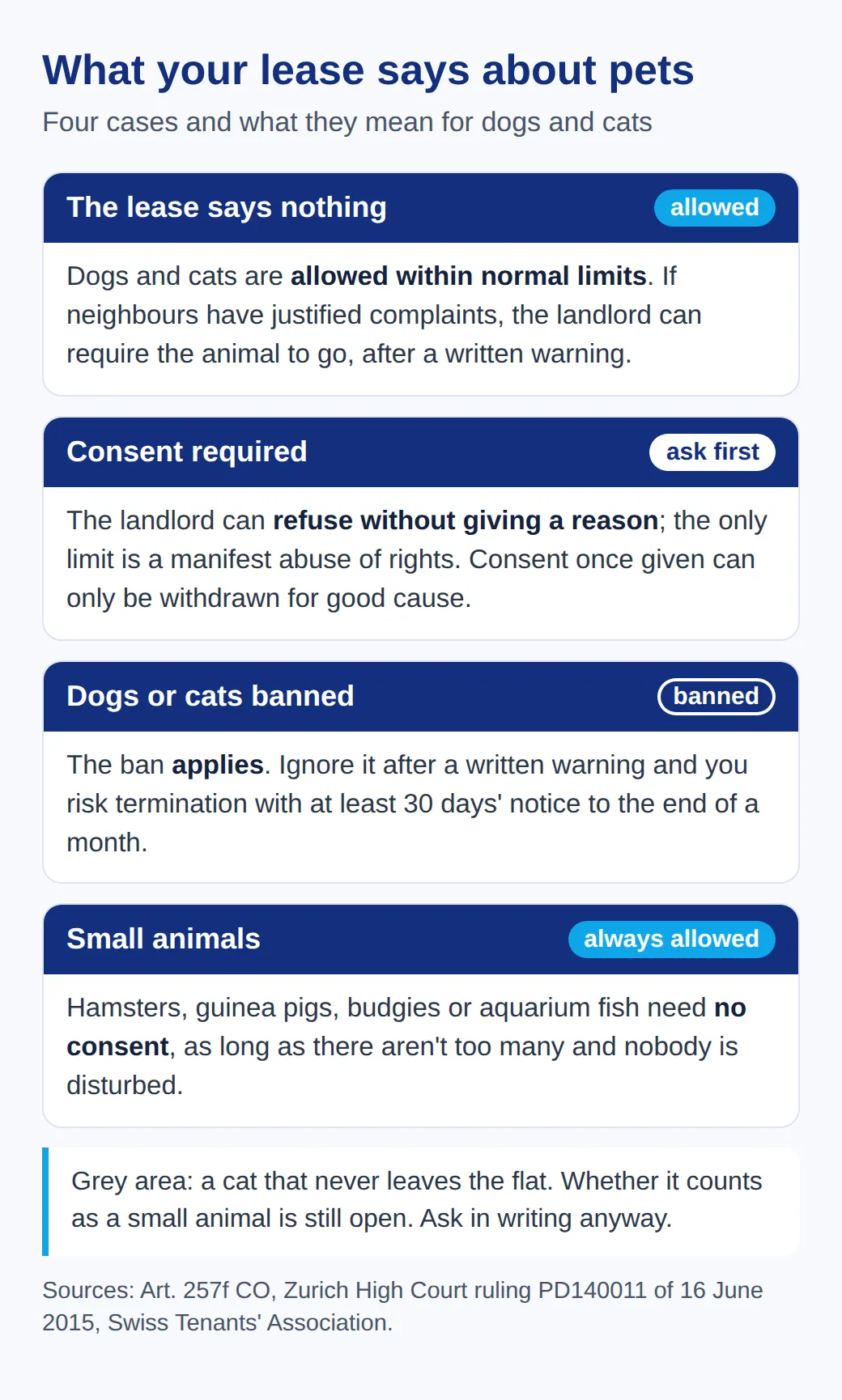
The Swiss Tenants' Association (Mieterinnen- und Mieterverband) describes the cases like this. If the lease says nothing about animals, you can keep a dog or a cat. The exceptions are animals that cause serious disturbance or could be dangerous, such as parrots or venomous snakes, and animals kept in large numbers. If neighbours have justified complaints, the landlord can require the animal to go, usually only after a written warning.
Small animals such as hamsters, guinea pigs, budgies or aquarium fish are always allowed, the association says, even if the lease bans pets. The limit is reached when there are too many of them or someone complains. An aquarium that requires alterations to the flat, on the other hand, needs written consent.
The cat is a borderline case. A cat that lives only indoors is increasingly treated like a small animal, the association writes, but no binding ruling has settled it. If you have a cat, it's better to ask anyway. Most leases don't leave the question open in any case: they use a consent clause, and that's where the real dispute starts.
Can a landlord refuse a dog without a reason?
Yes. Most Swiss leases make dogs and cats subject to the landlord's consent, and under case law a refusal needs no reason. The Federal Supreme Court ruled in 1994 that it made no difference whether a refusal had good grounds. The Zurich High Court reached the same result in 2015, although much of the legal literature takes the opposite view. That second case shows just how little good arguments achieve.
A case from a Zurich housing cooperative
A tenant had lived since 2005 in a two-room, ground-floor flat in a Zurich housing cooperative, paying CHF 530 a month net. Her lease terms allowed small animals without consent. For "keeping larger pets such as cats, rabbits, dogs, parrots, reptiles", they required the cooperative's written consent.
In March 2013 she asked to keep her boyfriend's dog from April, because he was going abroad for a long time. She enclosed a statement of agreement signed by most of her fellow tenants and a ready-made lease annex on keeping the dog. The board turned her down unanimously: it wanted to treat all members equally and granted no special permits.
The tenant went to the conciliation authority, where no agreement was reached, then to the rent tribunal and finally to the High Court. She lost before both courts. In ruling PD140011 of 16 June 2015, the High Court wrote that keeping the dog depended on a permission at the landlord's "free discretion". The only limit was the ban on manifest abuse of rights under Art. 2 of the Civil Code. Court fees and compensation to the cooperative cost her CHF 5,261.60 across both courts, not counting her own lawyer.
Two points in the ruling still help you. Once a landlord has given consent, it can only withdraw it for good cause, not at will. And the court wrote that, after more than 20 years, the Federal Supreme Court "might well take a different view" of the question. Until that happens, what counts is the written yes you have before you move in. If you're counting on fairness in the building, know how little weight it carries in law.
Equal treatment: why the cat next door doesn't count
A cat or dog already living in the same building gives you no right to the same. Tenancy law has no general principle of equal treatment, the Swiss Tenants' Association writes in its tenancy tip on keeping pets. Each permission applies to the lease it is written in.
Raising it can still be worth it. It won't help legally, but it may persuade the landlord, because unequal treatment can sour the mood in the building, the association says. Landlords like to turn the argument around, as the cooperative did in the case above: if nobody gets an exception, nobody needs an explanation.
With cooperatives, the rules are often already in the listing. Kraftwerk1, for example, writes on the letting page for its Koch estate that the estate is very densely occupied. It therefore allows no more than eight dogs and no cats at all. Smaller animals need no permit but are asked about in the application. If you're looking for a cooperative flat, read conditions like these before you apply; there's more on the search in our post on cooperative flats in Zurich. Beyond the lease, a second document usually matters too.
What the house rules can add
The house rules often set out how animals are kept in the building, and they are binding if your lease refers to them. That is what the Swiss Tenants' Association says.
You can see what's typical in the lease annex on keeping pets, published by the Institute for Interdisciplinary Research on Human-Animal Relations (IEMT) and offered for download by the association. In it, the tenant agrees among other things:
- to keep the dog on a leash in the stairwell, lift, laundry room, cellar and underground car park, without exception,
- to clear up dog mess on the property straight away and to help with cleaning if the animal dirties shared areas,
- to fit cat ladders and cat flaps only by agreement and at their own expense,
- when moving out, to clean carpets and floors so that no smells or hair are left behind.
In return, the annex states that the landlord should grant permission if you accept these conditions. But it only applies once both sides have signed, and in the High Court case it didn't help. It's still useful as an offer, because it answers the landlord's worries in advance. Send your request before you sign and before you get the animal, for example like this:
We are interested in the 3.5-room flat at [address] and have a female dog, mixed breed, 9 years old, about 12 kg. She is in the dog register and covered by liability insurance, and we have completed the mandatory courses. We would like to ask for your written consent to keep the dog and are willing to sign the lease annex on keeping pets.
If you only get a verbal yes, ask for a short confirmation by email. What happens if the animal moves in without a yes is the next question.
Moved in without permission: warning and termination
If you keep a dog despite a ban or without the required consent, you risk losing the flat. Under Art. 257f CO, the landlord must first issue a written warning. If you still don't comply and continuing the lease is no longer reasonable, the landlord can terminate it with at least 30 days' notice to the end of a month.
How this can end is shown by the 1994 Federal Supreme Court case that the High Court summarised in 2015. A tenant had received a refusal with reasons, got the dog anyway and did not give it away even after being told to do so within ten days. The termination was valid. What decided it was the breach of contract, not whether the refusal had good grounds.
There is one exception, but don't rely on it. If the landlord has known about a dog for a long time and said nothing, it counts as tacitly allowed, according to the Swiss Tenants' Association. A ban in the lease then no longer matters either. But a tacit permission can be withdrawn again if the dog causes problems. A dog you tell the landlord about upfront is almost always the better route, not least because the accounts are settled when the lease ends.
Damage when you move out: what you pay
You pay for damage beyond normal wear and tear, and even then only the current value. Under Art. 267 CO, you return the flat in the condition that results from using it as the lease intended. If your dog or cat was allowed, the animal is part of that use, but the scratches, holes or smells it leaves are not necessarily. The IEMT annex states explicitly that the tenant is liable for extra wear caused by the animal, for example to fitted carpets, wallpaper and doors.
How much you pay depends on the age of the damaged item. The yardstick is the joint lifespan table agreed by the tenants' and homeowners' associations. According to the table, a medium-quality fitted carpet lasts 10 years. If your cat has scratched a carpet that is 6 years old, 4 of its 10 years of value are left, so you pay 40 percent of the replacement. A carpet older than 10 years costs you nothing.
At the handover, the landlord must check the condition and report defects immediately, or it loses its claims, except for hidden defects (Art. 267a CO). Don't sign anything in the handover report that you don't agree with. Even with a pet, the deposit is capped at three months' rent (Art. 257e CO). The IEMT annex recommends getting written confirmation from your liability insurer that it covers such damage. Without that confirmation, the annex lets the landlord draw on the deposit. That covers the rental side. For dogs in Zurich, the paperwork with the authorities comes next.
Registering your dog in Zurich: Hundekontrolle and AMICUS
You register every dog older than three months with your municipality of residence within ten days. In the city of Zurich, you do this online with the registration form of the dog registration office (Hundekontrolle) of the City Police. The owner must be an adult and live in the city, and only one person is registered, even if the dog belongs to a couple.
At the same time, the dog must be registered to you in the national AMICUS database, also within ten days. If this is your first dog, the city gives you an AMICUS personal number after registration. If the dog isn't recorded anywhere yet, your vet registers it; if it's still listed under someone else, a change of owner is needed. The city explains this on its dog registration office page.
If you move within the city or give the dog away, the same ten-day deadline applies (§ 21 of the cantonal Dog Act, Hundegesetz). Who else needs your new address is covered in our post on moving in Zurich. Under the city's implementing rules, registration costs CHF 20, or CHF 40 if you're late. If the city has to make the AMICUS entry for you, it charges up to CHF 150. The annual tax costs more than registering.
Dog tax in the city of Zurich: CHF 160
For one dog, you pay CHF 160 a year in the city of Zurich. The amount has two parts: a CHF 130 levy for the city, set in the city's implementing rules, and a CHF 30 contribution to the canton under § 20 of the Dog Ordinance (Hundeverordnung). The Dog Act lets municipalities set the levy between CHF 70 and 200, and at CHF 130 the city sits roughly in the middle. You pay by the end of March for the whole calendar year.
| Case | Amount |
|---|---|
| Registration, on time | CHF 20 |
| Registration, late | CHF 40 |
| Dog tax per year | CHF 160 |
| Dog turns three months old after 30 June or is new to the canton | Half, CHF 80 |
| Dog dies before 30 June, no new dog | Half refunded |
Some rules in the Dog Act save money. If you have already paid the tax for the current year in another municipality or canton, you pay nothing in Zurich for that year; the payment receipt serves as proof (§ 21 Dog Ordinance). If a dog dies and you take on a new one, no tax is due for the rest of the year. Guide dogs for the blind as well as companion, assistance and therapy dogs are among those exempt, if their training and regular use are documented. If you receive supplementary benefits to AHV or IV (old-age or disability insurance), you can apply under the implementing rules to have the city levy waived for one dog per household.
None of this applies to cats: no tax, no registration with the municipality, no courses. For dogs, on the other hand, the courses have been mandatory since June 2025.
Courses and insurance: required for every dog
Since 1 June 2025, everyone who lives in a municipality in the canton of Zurich and keeps a dog for at least three months must complete practical training with it. If it's your first dog, you also need the theory course. This is set out in § 7 of the Dog Act, and the Dog Ordinance covers the details.
The ordinance puts the theory course at around two hours of learning, plus a test. You take it no earlier than a year before and no later than two months after you start keeping the dog or move to the canton. The practical training is six lessons of 60 minutes, at least a week apart, and more if not all learning goals are met after six lessons. It starts once the dog is at least six months old and must be finished within twelve months of you taking the dog on. Only trainers approved by the Cantonal Veterinary Office may run the courses, and you pay for them yourself.
There are a few exceptions. You don't need the theory course if you have kept a dog for at least six months in a row within the last ten years. A dog that is older than ten when you get it or move to the canton needs no practical training, and neither does one that was registered to an animal shelter in AMICUS, unless the shelter brought it in from abroad. If you already had your dog on 31 May 2025, you are exempt from both courses.
You also need liability insurance with at least CHF 1 million of cover for every dog (§ 6 of the Dog Act). Without it, the Dog Ordinance allows a fine of up to CHF 1,000; skip the training and you risk up to CHF 2,000. For some dogs, the question of courses never arises, because they aren't allowed to live in the canton.
Banned breeds: not every dog can come to Zurich
In the canton of Zurich it is illegal to acquire, keep or breed dogs on the so-called breed type list II, or to move into the canton with them. This also covers crossbreeds with at least ten percent of one of these breeds in their bloodline. You can't move to the canton of Zurich with such a dog, however dog-friendly the landlord may be.
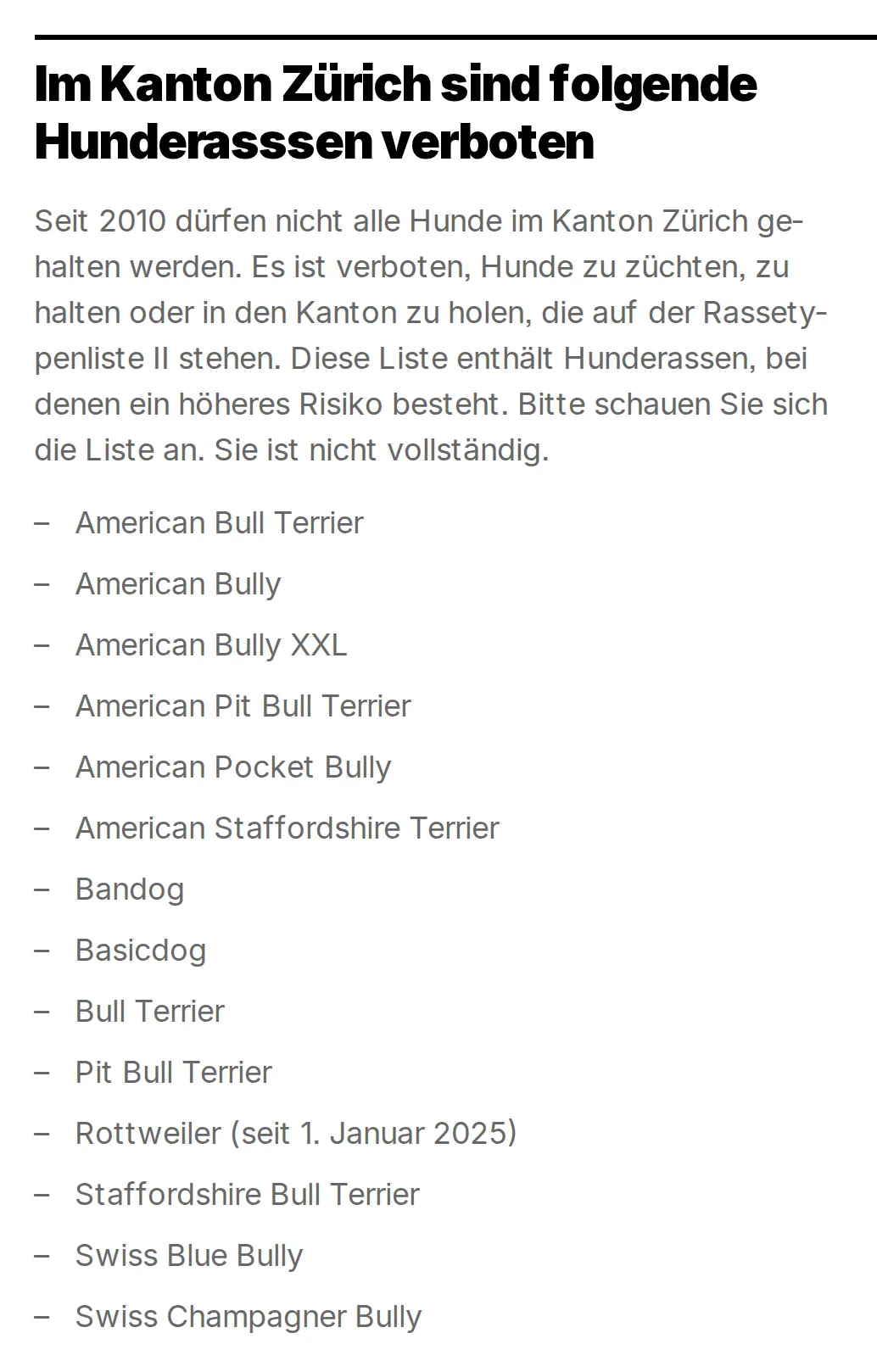
The canton's page on banned dog breeds names 14 breeds, including the American Staffordshire Terrier, the Pit Bull Terrier and several Bully types. Since 1 January 2025, the Rottweiler has been on the list too. If you already had a Rottweiler in the canton before that, you had to apply for a permit to keep it by 30 June 2025, and that deadline has passed. According to the canton, there is no test that would let you keep a banned dog after all. At the end of September 2026, the city of Zurich still had 30 registered dogs whose first-listed breed is on this list, 29 of them Rottweilers.
If you live outside the canton and visit with such a dog, you can stay no more than 30 days per calendar year, with a leash and muzzle in public places. Ignoring the ban can cost a fine of up to CHF 5,000. A second list for large breeds with extra course requirements was dropped in June 2025, because every dog now has to be trained anyway. For all permitted dogs, what matters day to day is mostly where they can run free.
Leashes, bans and off-leash areas in the city
A dog in Zurich can only run off the leash where there is no ban and no leash rule, and there are plenty of both. The cantonal Dog Act bans dogs from cemeteries, public pools, school playgrounds and play and sports fields. They must be on a leash in public buildings, on busy roads, on public transport and at stops. In the forest and up to 50 metres from its edge, a leash is required from 1 April to 31 July.
The city can designate further areas and has done so widely. We analysed the dog zones dataset (Hundezonen) on Open Data Zurich, which lists every legally designated area.
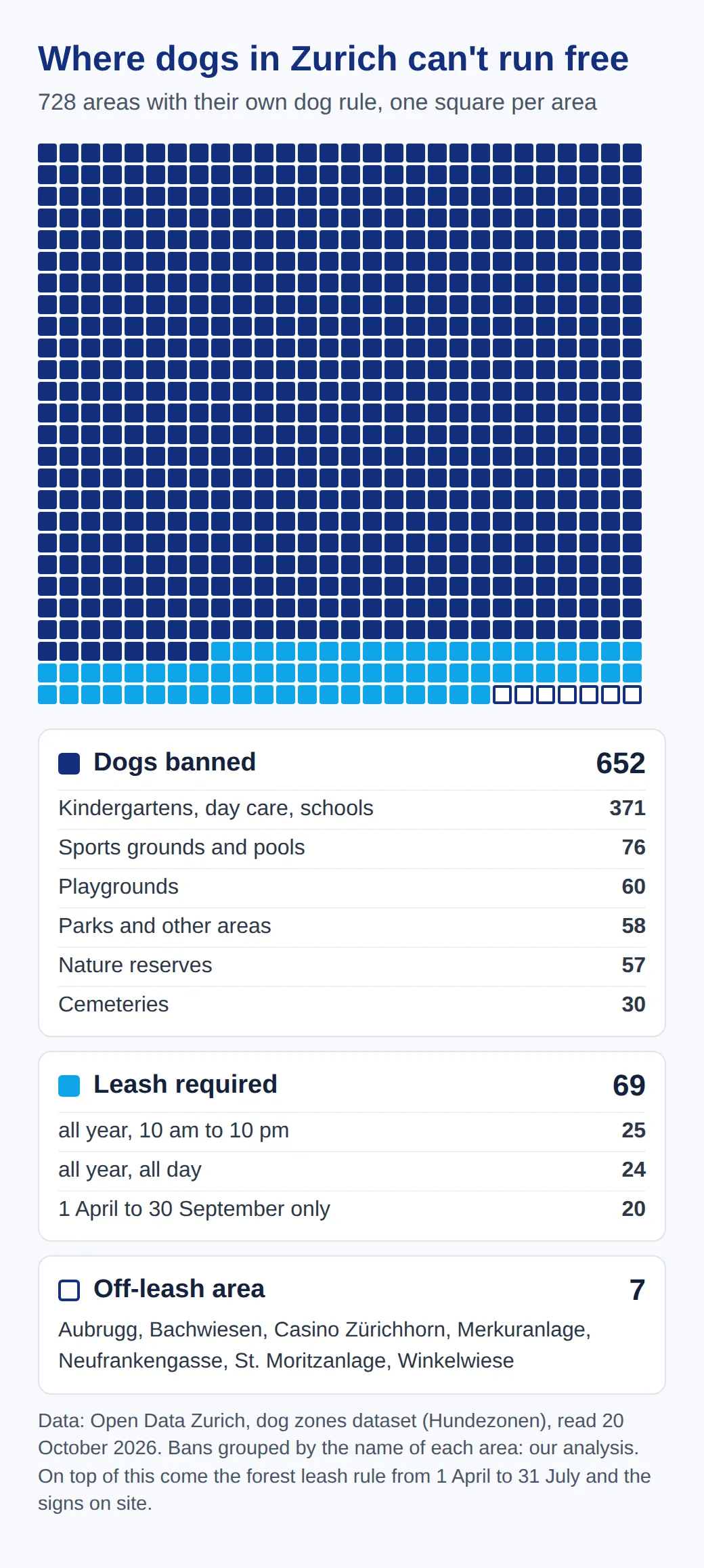
Of 728 areas, 652 ban dogs, most of them kindergartens, day care centres and schools. 69 areas require a leash, including the lakeside parks from Mythenquai to Tiefenbrunnen, where a leash is mandatory from 1 April to 30 September between 10 am and 10 pm. There are only seven designated off-leash areas, such as the Merkuranlage, the Bachwiesen and Casino Zürichhorn. The city's page on dogs advises following the signs on site. In residential areas and on streets and paths, always pick up dog mess and put it in any litter bin or dog waste bin.
For your flat search, this means a dog needs more than a permission in the lease: it also needs space to run within walking distance. A look at the map before you apply saves you long walks twice a day later.
What to sort out before you start looking
For every listing, first read what the lease and the house rules say about animals, and ask in writing before you sign if consent is required. Include with your application whatever answers the landlord's worries: your dog's breed, size and age, liability insurance, proof of the courses and an offer to sign the IEMT annex. In the city, budget CHF 160 a year in tax plus the cost of the courses, and register the dog within ten days of moving in.
When you rent a house, the same lease rules apply as above. But you don't share a stairwell with neighbours, and a garden of your own saves some of the walks.
And if a landlord says no, take them at their word. The Zurich case from 2015 shows that a court rarely changes that, while a written yes before you move in changes almost everything.
Common questions
Do I need my landlord's permission for an assistance dog in Switzerland?
Tenancy law has no special rule for this, so your lease decides. Some landlords make an exception here: even the Zurich cooperative in the High Court case said it could imagine allowing a guide dog for a blind person. Guide dogs, companion dogs, assistance dogs and therapy dogs are exempt from the dog tax if their training and use are documented.
Do I have to register my cat or pay tax for it in Zurich?
No. The cantonal dog law, with its registration duty, tax and courses, applies to dogs only. For a cat, what matters most is what your lease and the house rules say.
What do I have to do when I move to Zurich from another canton with my dog?
You register the dog with the city's dog registration office within ten days. If you have already paid dog tax for the current year in another canton, you hand in proof of payment and pay nothing in Zurich for that year. You only need the theory course if this is your first dog, at the latest two months after moving. The practical training must be finished within twelve months, unless the Cantonal Veterinary Office recognises equivalent training.
Can a landlord in Switzerland ask for a higher deposit because of a dog?
Only up to the legal limit. For a flat, the deposit can be at most three months' rent, and that cap covers everything together, with or without a pet.
Is my permission to keep a pet still valid if the building is sold?
Yes, if it is written into your lease. The Swiss Tenants' Association says a permission in the lease also binds the new owner. That is why it pays to have a verbal yes confirmed in writing.
More from the blog
All posts
Renting in Zurich with debt collection entries (Betreibung)
Renting in Zurich with a Betreibung on your extract: what landlords see, how to get disputed entries hidden under the 2026 rules, and who still rents to you.

Challenging the initial rent in Zurich: deadline, form, odds
How to challenge your initial rent in the canton of Zurich: the 30-day deadline, what the form must show, comparable rents and 2025 conciliation results.

Cheaper living near Zurich: rent, ZVV pass and tax 2026
Living near Zurich instead of in the city: what new tenants save on rent, and what the ZVV pass, tax rate and health insurance take back. 2026 figures.