Cooperative apartments in Zurich: how to get one in 2026

The short answer
In the city of Zurich, just over one in four rented flats belongs to a non-profit landlord, and the rents there are much lower. But there's almost nowhere left with a waiting list you can join. The city and the large cooperatives advertise vacant flats online for a short time and allocate them by lottery or by fixed criteria. Your chances improve if your household fits the number of rooms, your income is below the limits and your application is ready before the listing appears.
The old advice to get on waiting lists early and be patient hardly helps in Zurich any more. We show where the non-profit flats actually are, the rules the city, the Allgemeine Baugenossenschaft Zürich (ABZ) and the Familienheim-Genossenschaft Zürich (FGZ) use to allocate them, the figures that apply to occupancy, share capital and income, and how realistic your prospects are. The official pages and documents we link are in German; we found no English versions.
How many cooperative flats are there in Zurich?
At the end of 2023, 27.0 percent of all rented flats in the city were non-profit, around 58,100 flats in total. That figure comes from the City Council's report on housing policy 2020–2023, the latest official count using this definition. Non-profit (gemeinnützig) means the landlord doesn't aim to make a profit and charges only the cost rent, in other words what the flat actually costs to provide.
Around 41,300 of these flats belong to cooperatives (Genossenschaften). 15,600 belong to the city and its foundations, and about 1,200 to other non-profit owners. The city's municipal code (Gemeindeordnung) requires the share to rise to one third by 2050. So far it has stayed roughly level, because private landlords are building a lot too. The City Council expects more than 5,000 additional non-profit flats from known projects over the next ten years or so.
Why so many people want one of these flats is clear from the 2026 rent survey by Statistik Stadt Zürich. A typical 75-square-metre flat from a non-profit landlord costs a median of CHF 1,149 a month excluding ancillary costs (Nebenkosten), against CHF 1,987 from other landlords. That's CHF 838 less a month, or just over CHF 10,000 a year. The prices of the two groups barely overlap: only the cheapest quarter of private flats and the most expensive quarter of non-profit ones fall in the same range.
The rest of the market is tight as well. On 1 June 2026, there were 252 vacant flats in the whole city, 0.11 percent of the housing stock. So where you look makes a big difference.
Which districts to search in
Non-profit flats are spread very unevenly across the city's twelve districts, known as Kreise. To show this, we analysed the 2025 figures in Open Data Zürich's dataset on housing stock by type of owner. It counts all homes, including owner-occupied ones, and separates cooperatives from the public sector. So it measures something different from the City Council's report, but it shows well where you should be looking.
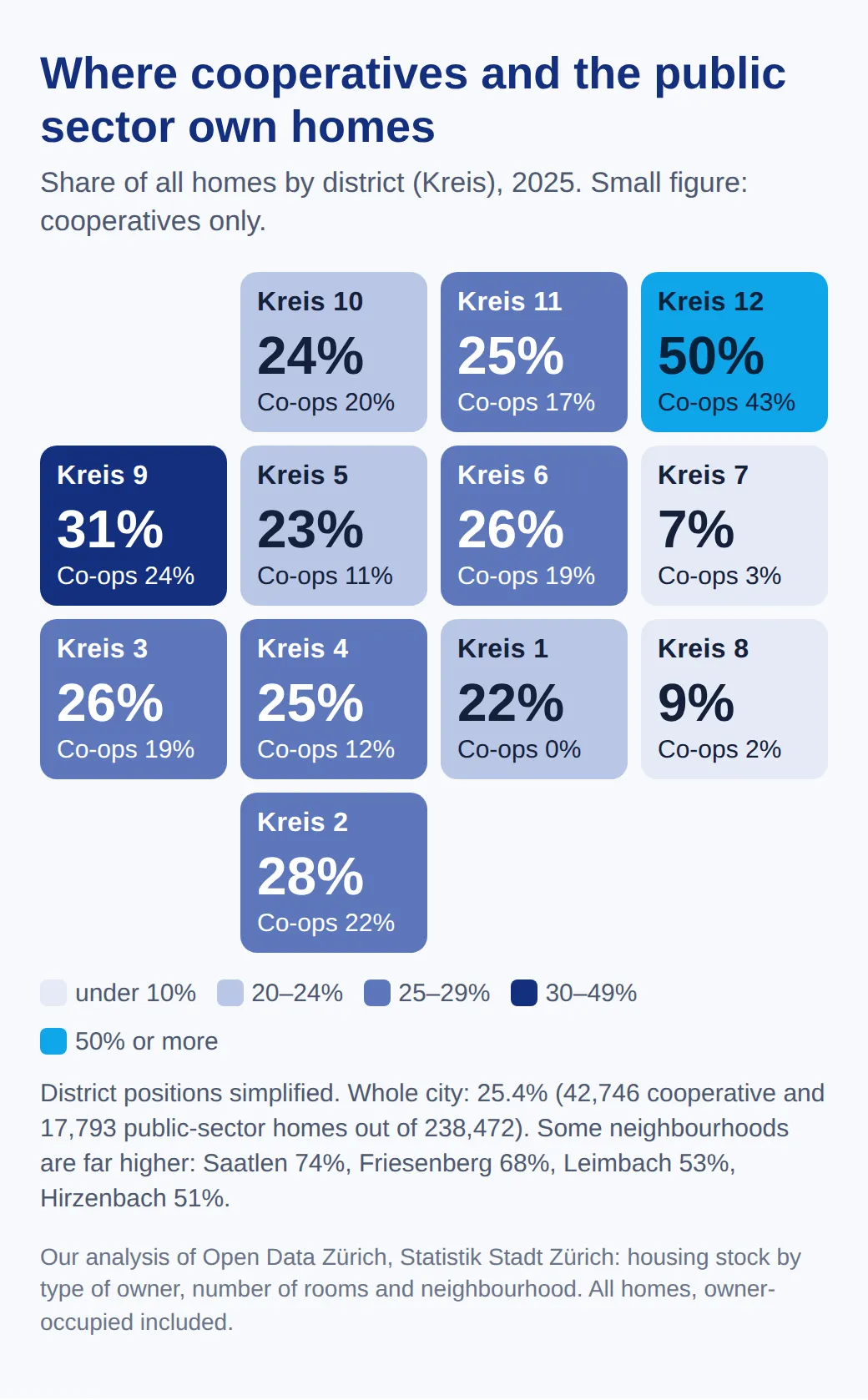
Across the city, 25.4 percent of all homes belong to cooperatives or the public sector. In Schwamendingen, Kreis 12, it's half, with 43 percent owned by cooperatives alone. Next come Altstetten and Albisrieden in Kreis 9, at 31 percent. On the Zürichberg and by the lake it's a very different picture: 7 percent in Kreis 7, with Fluntern, Hottingen, Hirslanden and Witikon, and 9 percent in Kreis 8 around Seefeld.
Some neighbourhoods stand out even more. In Saatlen, 74 percent of homes belong to cooperatives or the public sector, in Friesenberg 68 percent, in Leimbach 53 and in Hirzenbach 51 percent. At the bottom are Hottingen at 4 percent and Fluntern, Enge and Seefeld at 6 to 7 percent. If you're open to Schwamendingen, Albisrieden or Leimbach, you'll simply see more listings.
To find out which cooperative builds where, use the map of non-profit housing providers from the Zurich housing cooperatives association, Wohnbaugenossenschaften Zürich; its member list links to their websites. That's where you'll find the listings, and where you'll notice how fast they disappear.
Why there are hardly any waiting lists left
Most Zurich cooperatives advertise each vacant flat individually instead of keeping a list. The association says so in its tips for finding a flat. The city doesn't keep waiting lists either. Trying to get "on the list" somewhere just costs you time.
Where lists do still exist, they're mostly for existing tenants. The ABZ, which has 5,220 flats according to its 2025 annual report, 3,736 of them in the city of Zurich, keeps a waiting list only for people who have lived in one of its flats for at least five years. The Mieterbaugenossenschaft Zürich states in its letting rules that internal applications take priority and that a flat is only advertised publicly if it can't be let internally. The FGZ works in a similar way. What reaches the open market is often whatever is left after the internal moves.
And what's left goes fast. On the large property portals, cooperative listings often stay online for only 15 to 30 minutes, according to the association. In 2022, the FGZ described in its members' magazine how it works there: it had almost 2,300 flats at the time and 50 to 100 vacancies a year, and each listing stayed online until 30 applications had come in, usually within a few minutes. What happens after that varies a lot from landlord to landlord.
How cooperatives choose tenants
With some landlords, a lottery comes first; with others, a ranking based on fixed criteria. That changes what you should focus on.
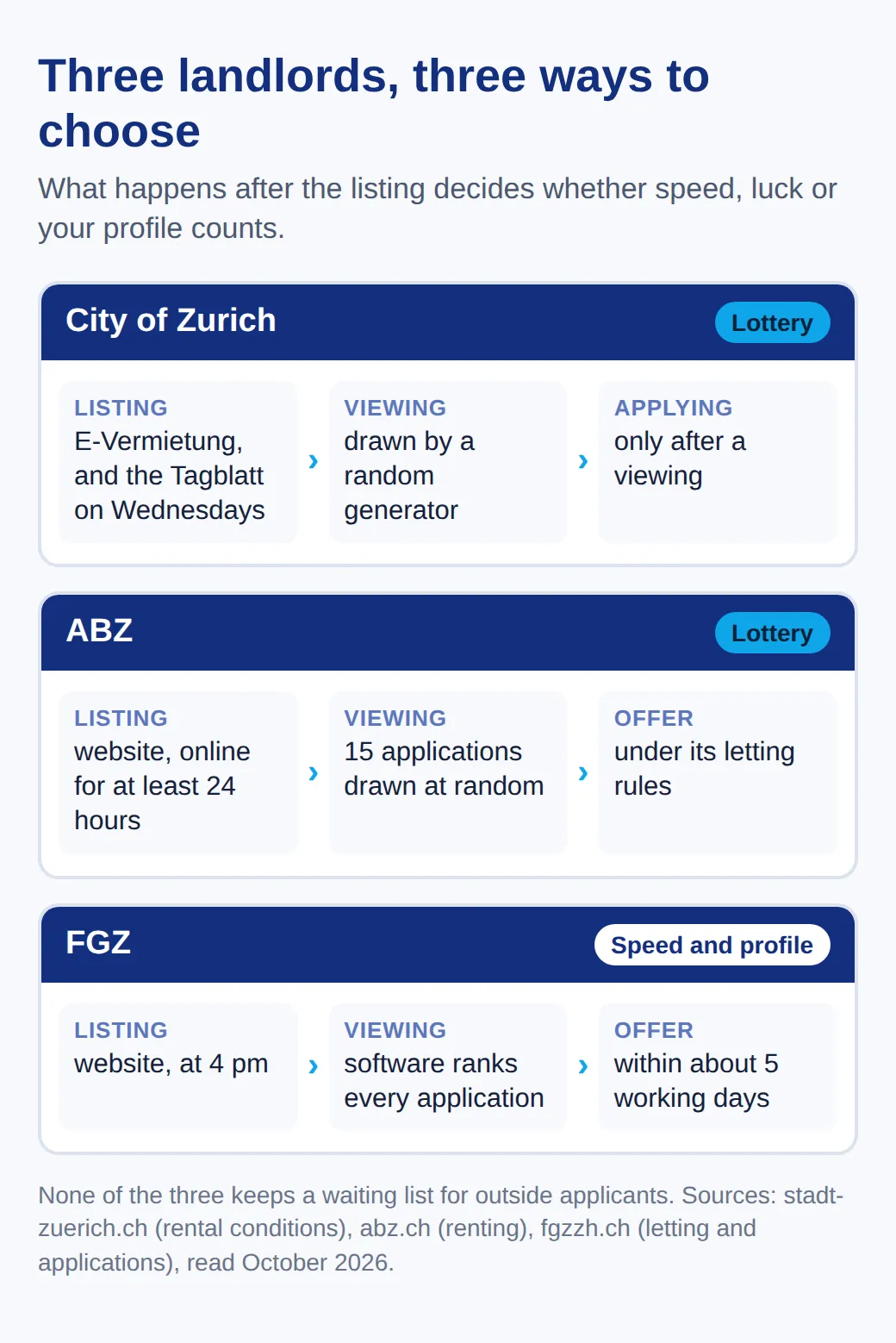
The ABZ keeps every vacant flat on its website for at least 24 hours. You apply online only; the ABZ says phone calls and emails don't help. Then 15 applications are drawn at random, and those applicants are invited to a viewing. The ABZ decides who gets the lease under its letting rules (Vermietungsreglement). It writes that its flats should mainly benefit people of modest financial means, and it gives preference to people who want to take part in community life on the estate. Here, what counts at the start isn't speed but luck. More applications for flats that suit you mean more tickets in the draw.
The FGZ works differently. Its listings appear only on its own website, always at 4 pm. A computer program ranks each application against the rules, and those who fit are invited to a viewing by email. After the viewing, you hand in a form with your latest tax details and hear back within about five working days. Low income and low assets are explicitly an advantage. Under its letting rules, external new tenants should come from levels 1 to 3, the FGZ's lowest income and asset brackets. So here both things count: being quick enough to be among the first applications, and fitting the profile.
Most other cooperatives sit somewhere in between. Before your first application, read the letting rules of the cooperative you're interested in. The FGZ and the Mieterbaugenossenschaft, for example, publish theirs online, and one rule turns up in nearly all of them.
Occupancy: rooms minus one
In most non-profit flats, the number of people living there must be at least the number of rooms minus one. The association calls "people plus one" the usual rule, and the City of Zurich sets it out in its rental conditions: at least three people must live in a 4.5-room flat. At the Mieterbaugenossenschaft Zürich, half rooms don't count.
The ABZ has a fixed table for this, and the minimum occupancy is then written into the lease:
| Flat size | At least |
|---|---|
| 1 to 2.5 rooms | 1 person |
| 3 to 3.5 rooms | 2 people |
| 4 to 4.5 rooms | 3 people |
| 5 to 5.5 rooms | 4 people |
| 6 to 6.5 rooms | 5 people |
For a couple without children, that means 3.5 rooms at most. According to the association, there's no point in a couple applying for a 4-room flat. The FGZ is stricter still: in its family flats, the number of rooms must equal the number of people, and single parents count as two. Children under 18 who live with you at least half the time each count as one person for city flats, and the Mieterbaugenossenschaft may count them too.
The rule still applies after you move in. If your children move out, the flat becomes under-occupied, and after a set period you have to move to a smaller one. At the city, that period is one year. The city now checks this in existing tenancies as well: around 1,100 of its non-subsidised flats are considered under-occupied. If your household fits the flat, the next hurdle is the money you pay in before you move in.
Share capital: the money you pay before moving in
When you rent a cooperative flat, you usually become a member and pay share capital (Anteilkapital). That's your share in the cooperative's equity, and you get it back after you move out. At the ABZ, the amount depends on the size of the flat: CHF 3,500 for 1.5 rooms, CHF 4,500 for 2.5, CHF 5,500 for 3.5, CHF 6,500 for 4.5, CHF 7,500 for 5.5 and CHF 8,500 for 6.5 rooms.
The amount is split between the parties to the lease, with at least CHF 1,500 per member. It must be paid in full by the time the flat is handed over, and the ABZ only gives you the keys against proof of payment. It doesn't accept rent deposit insurance. If you don't have the money, the ABZ itself names three ways: a private loan from relatives or friends, the social services covering it if you're on social assistance, or a loan from a third-party organisation such as one of the churches. Sort this out before you apply, not after you're offered the flat.
At the ABZ, you only become a member with an open-ended lease, and at the Mieterbaugenossenschaft the lease usually requires membership. A fixed-term flat, for example in a building due to be demolished soon, doesn't make you a member at either of them. The ABZ then rules out any right to another flat afterwards, and the Mieterbaugenossenschaft a place on its internal waiting list. The city itself has different rules.
City-owned flats: a lottery, not a waiting list
The city rents out around 7,400 non-subsidised flats at cost rent and just over 2,000 subsidised flats. Vacant flats appear on the E-Vermietung platform and every Wednesday in the Tagblatt der Stadt Zürich, the city's official gazette, and new flats also in the city's Ligi newsletter.
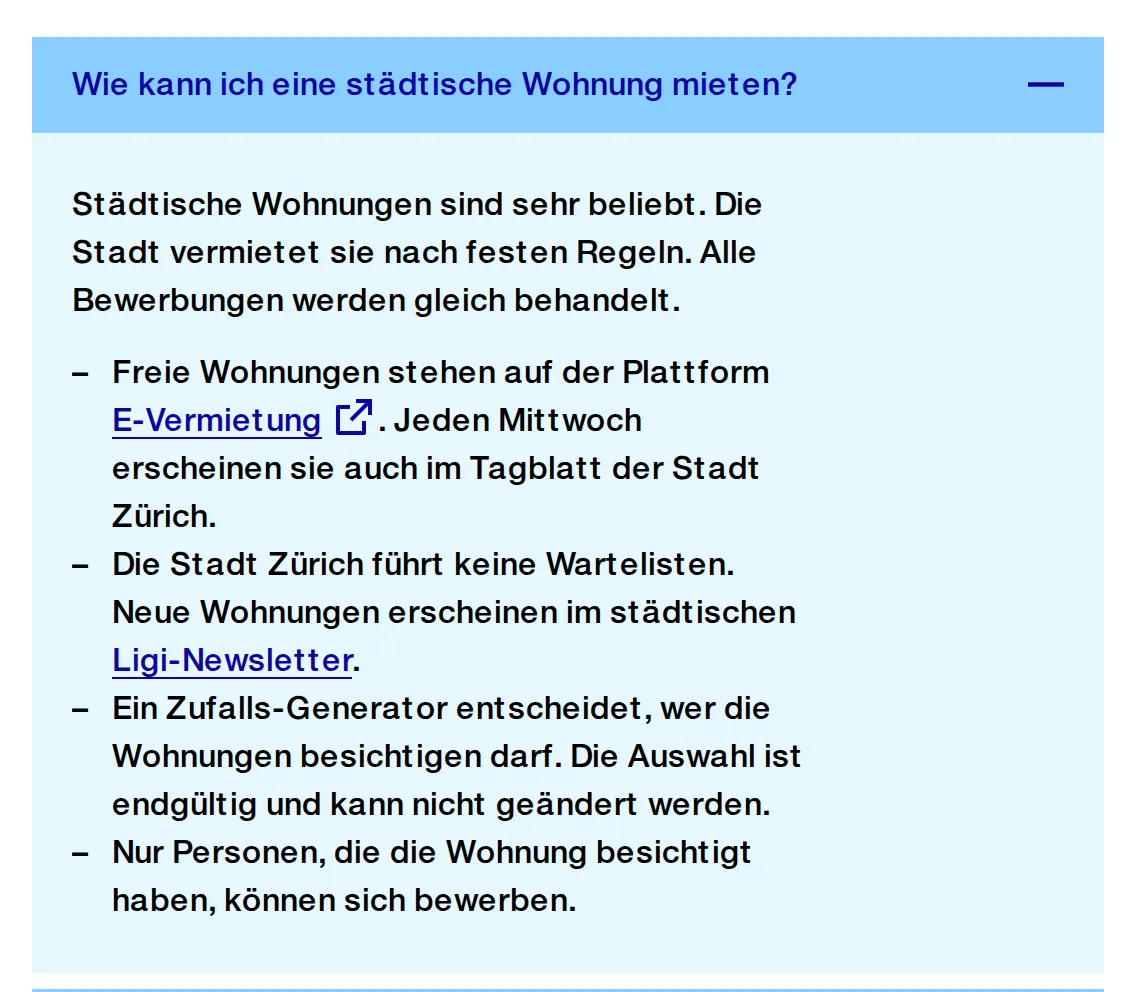
A random draw decides who may view a flat, and only those who have viewed it can apply. The non-subsidised flats are governed by the city's letting ordinance (Vermietungsverordnung). You must register your residence in the city by the start of the lease at the latest, and you may not use the flat as a second home. When the lease starts, the income of everyone in the household may be at most four times the gross annual rent. Income here means taxable income plus one tenth of taxable assets above CHF 200,000.
An example: if a flat costs CHF 1,500 a month gross, that's CHF 18,000 a year. Your relevant income may then be at most CHF 72,000 when the lease starts. The more expensive the flat, the higher your limit. For a cheap flat in an older building, you may hit it sooner than you think.
Later on, the rules relax. During the tenancy, you only exceed the limit if you earn more than CHF 70,000 a year and at the same time more than six times the annual rent including ancillary costs. Subsidised flats come with stricter figures, and those are set by the canton.
Subsidised flats: the 2026 income limits
Subsidised flats are meant for households on low incomes. The canton or the city reduces the rent, and in return fixed upper limits apply. According to the canton's housing subsidy page, the 2026 limits apply from 1 July 2026 to 30 June 2027 and are set out in fact sheet 9. What counts is your final assessed taxable income for 2025:
| Household | When you move in | After 4 years |
|---|---|---|
| 1 person | CHF 53,400 | CHF 59,800 |
| 2 or more people | CHF 63,000 | CHF 71,500 |
The incomes of everyone in the household are added together. If your assets exceed CHF 100,000, one twentieth of the amount above that is added to your income. Your assets themselves may not exceed CHF 200,000. For flats subsidised before 2005, fact sheet 8 gives higher figures for a second category; if in doubt, ask the landlord.
Two further conditions rule out many newcomers. You must have lived in the canton of Zurich for at least two years before the lease starts, and time registered as a weekly resident (someone who only lives here during the working week) doesn't count. And for its subsidised flats, the city requires Swiss citizenship or a B, C or S permit. According to the canton, subsidised flats with four rooms or more only go to families. The association says the limits are checked every two years. If you clear these hurdles, you're applying in a smaller field, which brings us to the question of your chances.
How good are your chances?
There's no guarantee, and nobody publishes how many applications each flat gets. The association itself writes that demand is far greater than supply, and that it takes patience and a bit of luck. A few figures still help you gauge your odds.
At the ABZ, the turnover rate in 2025 was 5 percent, according to its annual report. So about five in every hundred flats come free in a year, and some of those are likely to go to internal moves. At the FGZ, there were 50 to 100 vacancies a year in 2022, out of almost 2,300 flats.
Your prospects improve considerably if you belong to one of these groups:
- Families with children, because subsidised flats with four rooms or more and the FGZ's family flats are reserved for them.
- Households with a low income and few assets, who are explicitly given preference by the FGZ and others.
- People who are flexible about the neighbourhood and will also take Kreis 12, Kreis 9 or Leimbach.
- Young people in education or training who take a fixed-term flat in a building due to be replaced by a new one, an option the association mentions.
New builds are where the most movement is. When a whole estate is let for the first time, many flats come free at once. The ABZ, for example, is providing around 200 flats in the Koch-Quartier from spring 2027. Follow projects like this on the cooperatives' websites and in the city's Ligi newsletter.
Even so, think in months rather than weeks, and search the open market at the same time. Among landlords that aren't non-profit, Affoltern and Leimbach are the neighbourhoods with the lowest prices per square metre, according to the rent survey.
Your application, ready before the listing appears
Because you often have to react within minutes, your application dossier should be ready as a PDF. The association lists what's usually asked for: a recent extract from the debt collection register, your latest tax assessment, your salary certificate or your last three months' payslips, and a copy of your ID or residence permit. Add details of your job, employer and income, and the size and ages of everyone in the household.
Some cooperatives also want to know whether you'd take part in community life on the estate; the ABZ explicitly prefers people who want to help shape it. Write a few concrete sentences in advance that you only need to adapt. A sample:
We are a family with two children (aged 4 and 7) and have lived in Zurich-Altstetten since 2021. Our children go to kindergarten and school here, which is why we are looking in Kreis 9. In our current estate, we help organise the playground day. In the cooperative, we would like to join the estate committee.
Sign up for the newsletter or a search alert from every cooperative in the neighbourhoods you want, and note fixed times such as the FGZ's 4 pm or Wednesday for the Tagblatt. Only apply for flats whose occupancy rule fits your household. Every application that fails on the number of rooms costs you time you need for a listing that fits.
What you can do now
Check today whether your household is within the income limits and how many rooms you're entitled to. Then choose three or four cooperatives in neighbourhoods with a high share, read their letting rules and subscribe to their alerts. Put aside the share capital for the right size of flat, or arrange a loan. And finish your dossier before the first listing appears. If you have everything together for the first flat that fits, you're a step ahead of many other applicants.
Common questions
Can I apply for a cooperative or city flat in Zurich with an L permit?
Not for a subsidised flat: the city requires Swiss citizenship or a B, C or S permit. The FGZ asks for a Swiss passport or a B, C or Ci permit for all its flats. Other cooperatives set their own rules, so ask before you apply.
Do I have to live in Zurich already to apply for a cooperative or city flat?
Not for a non-subsidised city flat, but you must register your residence in Zurich by the time the lease starts at the latest. For a subsidised flat, you must have lived in the canton of Zurich for at least two years before the lease starts. Cooperatives such as the Mieterbaugenossenschaft Zürich require the flat you rent to be your main residence.
Do I get my share capital back when I move out of a cooperative flat?
Yes. At the ABZ, you get the money back after you move out, once you have met all your obligations under the lease. So don't count on having it in hand on moving day to pay for your next flat.
What happens if my income goes up after I move into a city flat?
In a non-subsidised city flat, you only exceed the limit if you earn more than CHF 70,000 and at the same time more than six times the annual rent. The city will check individual households from 2028 at the earliest, and only if more than 15 percent of tenants exceed the limits. For subsidised flats, higher limits apply after four years, and compliance is checked every two years.
Is it worth paying for an alert service for cooperative flat listings?
Such services pass on listings that are public anyway. The Zurich housing cooperatives association points out that they are run by third parties and have nothing to do with it. The large landlords offer their own alerts, such as the ABZ newsletter or the city's Ligi newsletter.