Cheaper living near Zurich: rent, ZVV pass and tax 2026
The short answer
If you rent a 3-room flat in a building from 1945 to 2000 as a new tenant, you pay on average CHF 357 a month less in the suburbs around Zurich than in the city. About CHF 33 of that goes on the ZVV travel pass. Health insurance gets cheaper, and taxes can help or hurt depending on the municipality. In our examples, you end up CHF 375 to 454 a month better off.
Listing prices alone tell you little about this. So we put together the official figures that decide your household budget: the rents that new tenants in the canton of Zurich actually pay, the ZVV zone fares, the tax rates of every municipality and the health insurance premium regions. The result is a calculation you can repeat for any municipality yourself.
How much cheaper is rent around Zurich?
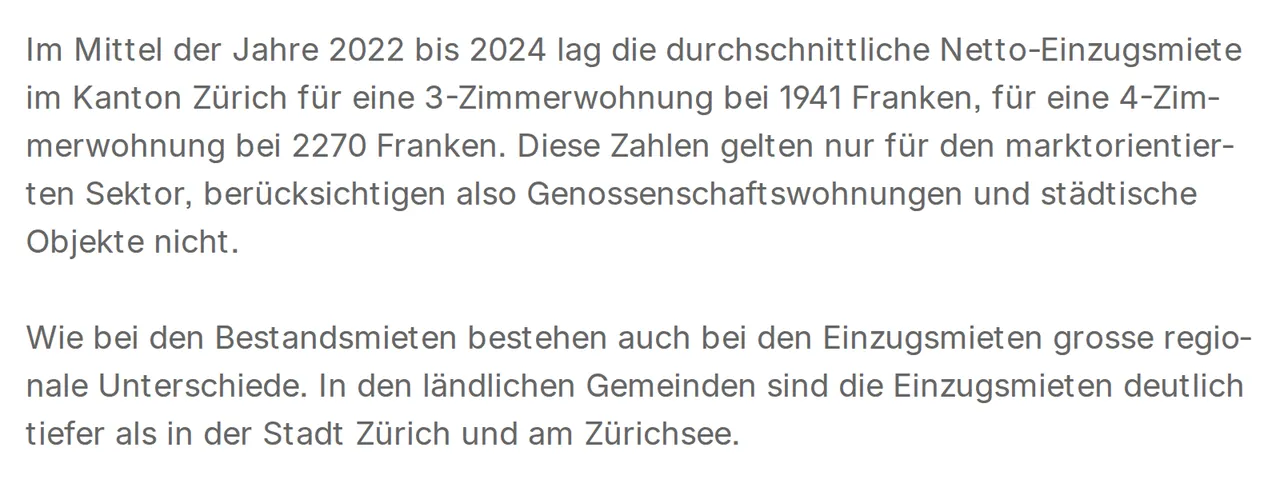
A flat that comes up for rent around the city is clearly cheaper, but not by the same amount everywhere. The best basis for this comes from the Statistical Office of the Canton of Zurich. It analysed the federal structural survey for 2022 to 2024 and worked out what it calls move-in rents: the net rents of households that have just moved in, which are exactly the prices you face when you search. Cooperative and city-owned flats are not included.
For these figures, the canton sorts its municipalities into five groups: the city of Zurich, the city of Winterthur, the lakeside municipalities, the agglomeration and the countryside. The agglomeration has 55 municipalities, among them Schlieren, Dietikon, Dübendorf, Wallisellen, Opfikon, Kloten, Regensdorf, Uster and Adliswil. The lakeside group includes Thalwil, Horgen, Küsnacht and Meilen. The countryside covers 88 mostly smaller municipalities from the Weinland to the Zurich Oberland. Which group each municipality belongs to is in the data sheet on move-in rents.
For a 3-room flat, the averages look like this, in francs a month and by the year the building went up:
| Area | Built before 1945 | 1945 to 2000 | 2001 or later |
|---|---|---|---|
| City of Zurich | 2,119 | 1,989 | 2,599 |
| Lakeside | 1,945* | 1,931 | 2,500 |
| Agglomeration | 1,811 | 1,632 | 2,194 |
| Countryside | 1,516 | 1,523 | 1,917 |
| City of Winterthur | 1,512* | 1,448 | 1,968 |
Figures with an asterisk are based on fewer than 50 observations. From here on we work with the middle column, because it rests on at least 50 cases in every area. There, the agglomeration is CHF 357 below the city, the countryside CHF 466 and Winterthur CHF 541. By the lake, you save next to nothing.
The last column holds a trap. A new build in the agglomeration costs more on average than an older flat in the city. If you want to live cheaply outside the city, look mainly at existing buildings from 1945 to 2000. For the projects going up in the city itself, see our article on new-build flats in Zurich. Within the agglomeration, too, the differences are large.
Where rents in the canton are lowest
Tenants pay least in the Weinland and in Winterthur, and most on the north-eastern shore of Lake Zurich. That comes from a second analysis by the canton, across twelve regions, which counts every current tenancy, including old leases and cooperative flats. These rents on existing tenancies are lower than move-in rents, but they are good for comparing regions.
A 3-room flat costs CHF 1,486 on average in the Weinland, 1,489 in Winterthur and 1,504 in the area around Winterthur. Next come the Zurich Unterland at 1,549, the Oberland at 1,559, the Furttal at 1,570 and the Limmattal at CHF 1,591. The Knonaueramt is dearer at 1,622, the Glattal at 1,707 and the Zimmerberg at CHF 1,717. The city of Zurich stands at CHF 1,761, and the Pfannenstiel region on that same shore even beats it at CHF 1,835. The figures are in the data sheet on existing rents.
There is a reason the gap looks smaller here than with move-in rents. In the city of Zurich, a large share of rented flats belongs to the city and to cooperatives, and their low rents pull the average down. You can only get one of those flats by applying to the city or a cooperative, as we explain in our article on finding a cooperative flat in Zurich. On the open market, the table above is what counts.
Cheap only helps if you can get it. On 1 June 2026, 0.52 percent of flats across the canton stood empty, according to the canton's vacancy count. In the city of Zurich the figure was 0.11 percent, in Winterthur 0.20 percent. The most choice was in the Oberland, at 0.95 percent, and the Pfannenstiel, at 0.90. Where more flats are free, you have more choice and more time to decide. And since you travel there and back every day, the commute belongs in the sum.
What the ZVV pass costs outside the city
Just across the city boundary, the annual pass for the trip into the city costs CHF 397 more, and from Winterthur CHF 1,523 more. The reason is a rule of the Zurich Transport Network (ZVV): fare zones 110 for the city of Zurich and 120 for Winterthur each count as two zones. If you live and work in the city, you need a pass for 1–2 zones. If you live in a neighbouring zone, you need three.
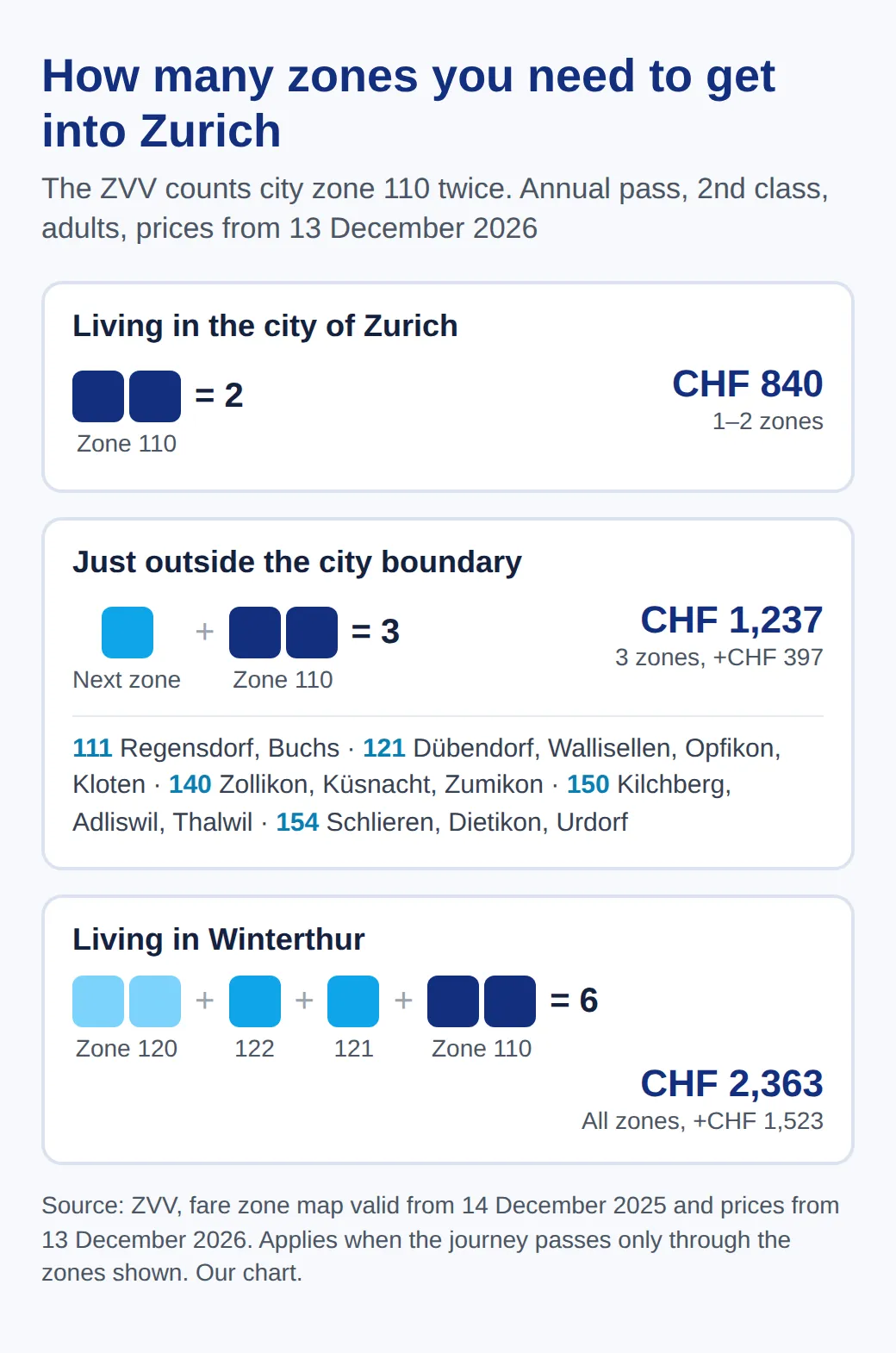
According to the zone map, the neighbouring zones include 111 with Regensdorf and Buchs, 121 with Dübendorf, Wallisellen, Opfikon and Kloten, 140 with Zollikon and Küsnacht, 150 with Kilchberg, Adliswil and Thalwil, and 154 with Schlieren, Dietikon and Urdorf. Every zone you travel through counts. Bülach, for example, is in zone 112, and the train runs through zone 121, which makes four zones. Winterthur comes to six via zones 122 and 121, and for that the only option is the all-zones pass.
Until 12 December 2026, the personal NetworkPass for adults in 2nd class costs CHF 813 a year for 1–2 zones, 1,200 for 3 zones, 1,579 for 4 zones and CHF 2,308 for all zones. Prices go up on 13 December. According to the price list from 13 December 2026, you then pay 840, 1,237, 1,616 and CHF 2,363. We use these new prices, because they apply to a pass you buy after a move in the coming months. Per month, that is CHF 33 more than in the city for three zones, and CHF 127 more for all zones.
Two things shift this calculation. If you don't need a pass in the city today because you cycle, you pay the full CHF 1,237 after the move, about CHF 103 a month. And in the city, the annual pass for zone 110 is meant to cost CHF 365 one day. Voters approved the initiative in September 2025. In its implementation proposal, the City Council wants to grant the discount from spring 2028 at the earliest, only to people whose main residence is in the city, and only after another popular vote. If the city pass then costs CHF 365, as the initiative demands, the gap on the pass grows to CHF 872 a year.
A small part comes back through tax. In the canton of Zurich, you can deduct the cost of your pass to work as a work-related expense for cantonal and municipal tax, together with other travel costs, up to CHF 5,200 a year. That is set out in the Finance Directorate's directive. But the same applies to the city pass, so the benefit is limited to the difference. And money is only half of what commuting costs you.
How long the commute into Zurich takes
From many places in the agglomeration, you reach the main station faster than from the city's outer neighbourhoods. We checked the timetable for the fastest of four connections from about 7.30 am on a Tuesday morning in October 2026. The train takes 9 minutes from Wallisellen and Thalwil, and 10 to 11 minutes from Schlieren, Dietikon and Urdorf. From Schwamendingerplatz, tram and S-Bahn take 17 minutes, and from Witikon 21 minutes.
| Municipality | Train to Zurich HB | Zones | Tax rate 2026 |
|---|---|---|---|
| Wallisellen | 9 min | 3 | 93% |
| Thalwil | 9 min | 3 | 78% |
| Glattbrugg (Opfikon) | 10 min | 3 | 94% |
| Urdorf | 10 min | 3 | 115% |
| Schlieren | 11 min | 3 | 111% |
| Dietikon | 11 min | 3 | 121% |
| Dübendorf | 12 min | 3 | 92% |
| Kloten | 15 min | 3 | 100% |
| Regensdorf-Watt | 17 min | 3 | 117% |
| Bülach | 18 min | 4 | 114% |
| Winterthur | 19 min | all | 125% |
The journey times run from station to station. You have to add the walk or ride to the stop yourself, and that is exactly where a place either suits you or doesn't. If you live by the station in Dietikon, you reach Zurich main station faster than someone in Witikon. With ten minutes on a bus first, that advantage is gone. In Thalwil, only the fastest InterRegio manages the 9 minutes; by S-Bahn it takes 13 to 18. The figures in the last column lead to the next question.
Tax rate: lower, higher or the same as in the city
Your municipality's tax rate can make the move pay off more or eat into part of the saving. In 2026, the city of Zurich levies a municipal tax rate (Steuerfuss) of 119 percent, excluding church tax. That is in the list of municipal tax rates that the canton keeps for all 160 municipalities. On top of that, everyone pays the cantonal rate of 95 percent, which is the same everywhere.
This is how it works. From your taxable income, the canton calculates the simple cantonal tax. Your municipality then charges the percentage of it set by its tax rate. So every percentage point less saves you one hundredth of the simple cantonal tax. With a simple cantonal tax of CHF 3,278, as in our example below, 10 percentage points come to about CHF 328 a year.
The pattern in the canton is awkward. The municipalities with the lowest taxes are where rents are highest. By the lake, the median tax rate is 79 percent, with Kilchberg at 72 and Küsnacht at 73 percent. In the agglomeration the median is 106 percent, with wide differences: Zumikon charges 71, Dübendorf 92, Dietikon 121 and Affoltern am Albis 122 percent. In the countryside the median is 112 percent, and Winterthur comes to 125 percent. So if you move to Dietikon or Winterthur for the rent, you pay a little more tax than in the city.
We worked out how much that matters with the Federal Tax Administration's tax calculator for 2026. A single person with no church membership and a gross salary of CHF 80,000 pays CHF 7,945 in income tax in the city of Zurich, federal tax included. In Dübendorf it is CHF 7,060, so 885 less. In Schlieren they save CHF 262, in Thalwil CHF 1,344. In Dietikon they pay CHF 65 more, in Winterthur CHF 197 more. For a married couple with two children and a combined salary of CHF 130,000, the gaps are almost the same: CHF 880 less in Dübendorf, CHF 65 more in Dietikon. Then there is an item that many comparisons leave out: health insurance.
Health insurance gets cheaper outside the city
Basic health insurance costs noticeably less outside the city of Zurich, because the canton is divided into three premium regions. Region 1 is the city of Zurich alone. Region 2 has 37 municipalities, among them Winterthur, Schlieren, Dietikon, Urdorf, Dübendorf, Wallisellen, Opfikon, Kloten, Regensdorf, Uster, Adliswil and Thalwil. All the other municipalities, such as Bülach, Wetzikon or Affoltern am Albis, form region 3. The list for 2027 is published by the Federal Office of Public Health.
The average premiums the federal government sets for supplementary benefits show how big the difference is. For 2026, according to the FDHA ordinance, they come to CHF 7,680 a year for adults, accident cover included, in region 1, 7,008 in region 2 and CHF 6,528 in region 3. That is CHF 56 a month less per adult in region 2 and CHF 96 less in region 3. For children, the gap between regions 1 and 2 is about CHF 14 a month.
Your own premium depends on your insurer, your model and your deductible. Insurers may charge lower premiums in regions 2 and 3, and each one decides how much lower within the limits the federal government sets. On average, for a family of two adults and two children in region 2, the gap comes to about CHF 140 a month, more than the extra cost of two 3-zone passes (CHF 66). Now everything can be added up.
Adding it up for four municipalities
For one adult earning CHF 80,000 who is looking for a 3-room flat in a building from 1945 to 2000, moving out of the city is worth CHF 375 to 454 a month. To get there, we added up the four parts: the lower move-in rent of the municipality group, the dearer pass, the municipality's taxes and the average premium of the region.
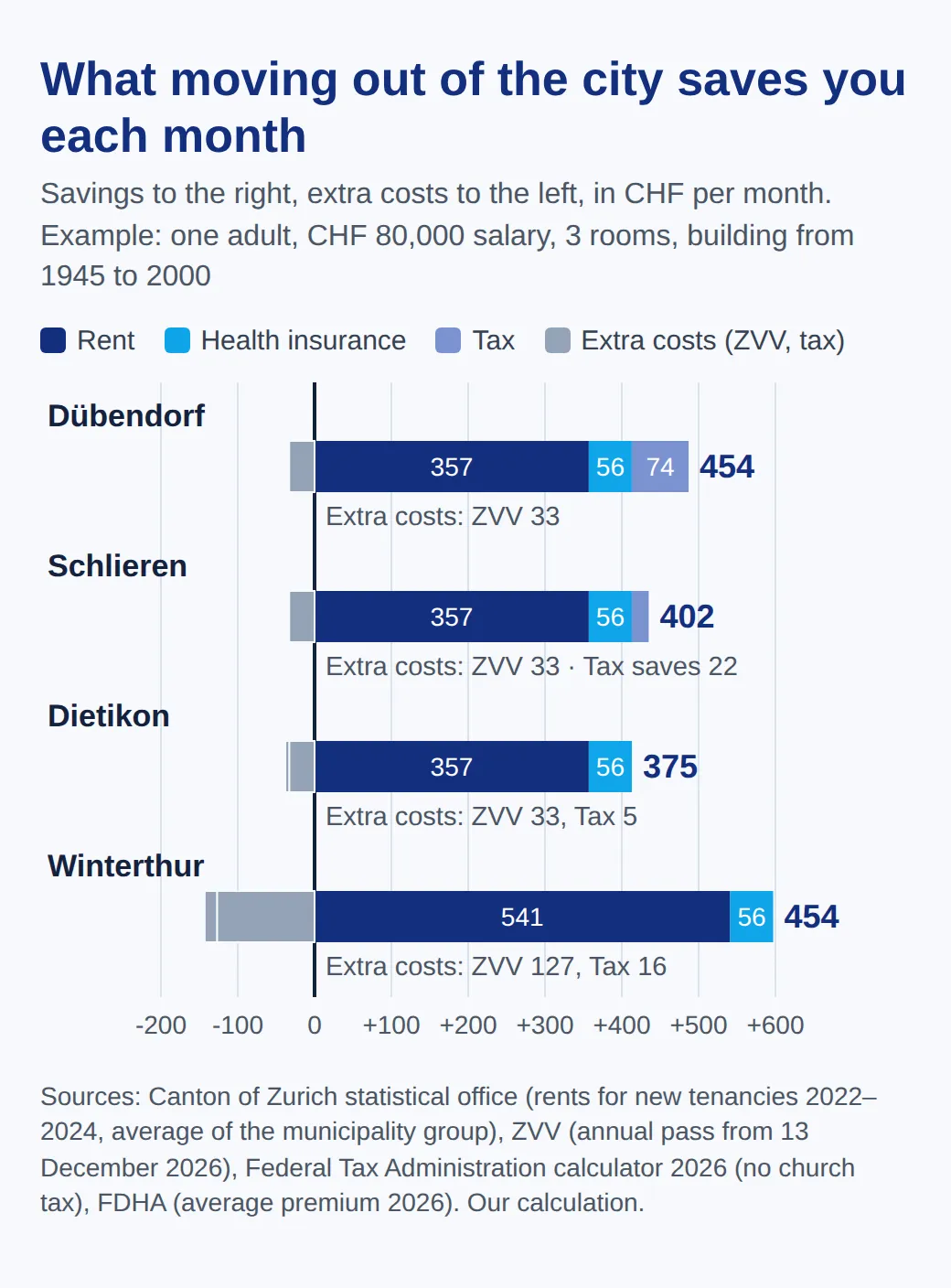
Dübendorf comes out best, because every part points the same way. In Schlieren the slightly lower tax rate helps, while in Dietikon the higher one costs a few francs. Winterthur ends up level with Dübendorf despite the expensive pass, because rents there are the lowest. The catch: of the four places, it keeps you on the train the longest.
The rent figure is an average across all the municipalities in a group. The canton doesn't publish figures for individual municipalities, and the group runs from Zumikon to Dietikon. So always check the actual listing: if its price is above the average in the table, your saving shrinks franc for franc. How to compare a listing per square metre with Zurich's districts is in our article on rents by district.
What the sum leaves out is time. Ten minutes more each way adds up to a good 73 hours a year over 220 working days. If you work from home, you travel less often and could buy single tickets instead of an annual pass. If you commute by car, you need a completely different calculation; our sum doesn't cover those costs.
When the city still pays off
For some households the city stays the cheaper choice. Above all, that is the case if you get a cooperative or city-owned flat, because their rents are far below every figure in this article. It is also the case if you can do without a pass and cycle to work. And it is the case if you search in a cheaper neighbourhood: according to the city's 2026 rent survey, flats outside cooperatives and city ownership are cheapest per square metre in Affoltern and Leimbach, while Schwamendingen, Seebach and Höngg are about CHF 3 below the city median.
If you are searching in the city, you will find current listings on our overview for Zurich.
What you can do now
Before you start searching, settle three figures for your household: how many zones you need to get to work, which tax rate applies in the municipalities on your list and which premium region they are in. Then weigh each listing against a comparable flat in the city: lower rent, minus the extra cost of the pass, plus or minus tax, plus the lower premium. Look mainly at existing buildings and at municipalities with a station you can walk to. When you move, deregister in the city and register in your new municipality. What to watch out for is in our article on moving in Zurich.
Common questions
Do these figures apply to towns in Aargau or Schwyz?
No. The rent statistics, tax rates and premium regions in this article cover the canton of Zurich only. If you move to Spreitenbach or Freienbach, for example, you pay another canton's taxes and your commute crosses the cantonal border, which is priced with the Z-Pass fare. Use that canton's figures there and work it out the same way.
Is church tax included in the tax figures?
No. Our tax examples leave church tax out, and you only pay it if you belong to one of the recognised churches. It comes on top as its own rate: for members of the Reformed Church, for example, 10 percent of the simple cantonal tax in the city of Zurich, 11 in Dübendorf and 12 percent in Dietikon. That barely changes how the municipalities compare.
Can commuters use Zurich's 365-franc travel pass?
No. Under the City Council's proposal, only people whose main residence is in the city of Zurich will get the discount. It is planned for spring 2028 at the earliest, and another popular vote has to come first. Nothing changes for commuters from the suburbs.
How up to date are the canton's rent figures?
They come from the federal structural survey for 2022 to 2024, which the canton pooled. Rents have kept rising since: in the city of Zurich, by 3.1 percent per square metre between 2024 and 2026, according to the city's own survey. For the gap between the city and the towns around it, they are still the best official figures there are.
Is a new-build flat outside Zurich worth it?
Rarely, if money is all that counts. New tenants of a 3-room flat in a building from 2001 or later in the suburbs pay CHF 2,194 on average, more than for a flat from 1945 to 2000 in the city. New builds are often larger and better fitted, though, so compare the price per square metre too.
More from the blog
All posts
Renting in Zurich with debt collection entries (Betreibung)
Renting in Zurich with a Betreibung on your extract: what landlords see, how to get disputed entries hidden under the 2026 rules, and who still rents to you.
Renting with a dog in Zurich: landlord consent and dog tax
Dog or cat in a Zurich rental: when your landlord can say no, what you pay for damage on moving out, plus registration, the CHF 160 dog tax and banned breeds.

Challenging the initial rent in Zurich: deadline, form, odds
How to challenge your initial rent in the canton of Zurich: the 30-day deadline, what the form must show, comparable rents and 2025 conciliation results.