New-build flats in Zurich: where they go up in 2026 and 2027
At a glance
At the end of 2025, 7,097 flats were under construction in the city of Zurich and another 7,199 had been approved. A third of them are in Kreis 11, the district that covers Oerlikon, Seebach and Affoltern, and many more in Altstetten, Albisrieden and Schwamendingen. Private companies are building almost two thirds. The largest non-profit new builds ready by mid-2027 are in the Koch quarter in Albisrieden.
If you look for new-build flats in Zurich, you mostly find listings for single projects. They don't tell you which buildings will be finished when, who is building them or which neighbourhoods have the most building sites. So we analysed the city's construction and housing statistics, read the project pages of the city and the cooperatives, and put together when and where you can apply. The official pages and datasets we link are in German; we found no English versions.
How many flats are being built in Zurich?
In 2025, 2,977 flats in new buildings were completed in the city of Zurich, 347 more than the year before. That is the figure from the city's statistics office, Statistik Stadt Zürich, in its review of building activity. Conversions added another 547 flats, more than ever before. A third of those are in a single building: the former Swissôtel in Oerlikon, now the residential tower Oerlikon One.
At the same time, 1,379 flats were demolished, more than in any year except 2021. Taking conversions and register corrections into account, the housing stock grew by 2,070 flats to 238,472. The figures for recent years show how much demolition slows the growth:
| Year | Newly built | Demolished | Difference |
|---|---|---|---|
| 2019 | 1,979 | 381 | 1,598 |
| 2020 | 1,772 | 612 | 1,160 |
| 2021 | 1,929 | 1,767 | 162 |
| 2022 | 2,566 | 1,137 | 1,429 |
| 2023 | 3,047 | 1,043 | 2,004 |
| 2024 | 2,630 | 840 | 1,790 |
| 2025 | 2,977 | 1,379 | 1,598 |
The figures come from the open data set on flats from new construction and demolition. Conversions are not included in the difference.
In Zurich, building almost always means tearing something down first. Of the 2,977 new flats in 2025, only 116 stood on land that had been empty before, according to the data set on the type of replacement build. 1,464 replaced older residential buildings, and 1,397 were built in buildings or on sites that had not been used for housing, such as offices or commercial premises. For you as a tenant, that cuts both ways. A replacement building brings more flats, but the existing tenants have to move out first. And before demolition, old flats are often only let on fixed-term leases.
And more is on the way. In 2025 the city approved 79 new residential projects with almost 3,000 flats, after 66 projects with 2,200 flats the year before. The next analysis shows where those flats will be.
Where new flats are being built in Zurich
Most new flats are going up in the north and west of the city. We analysed the data set on new flats by project status for this. For every neighbourhood, it counts how many flats were under construction or approved at the end of 2025. Zurich's twelve districts are each called a Kreis and known by their number.
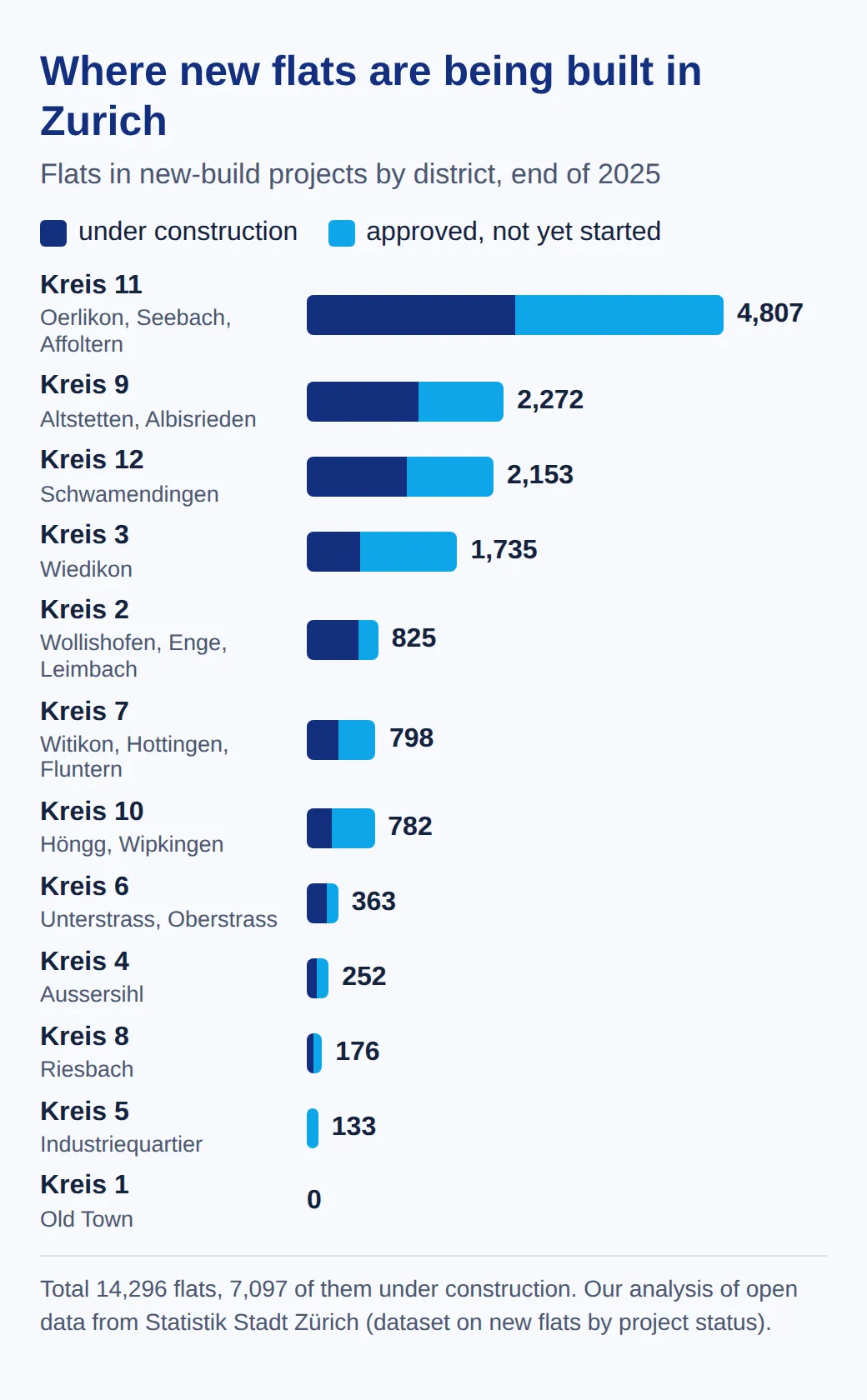
Kreis 11 alone accounts for 4,807 flats, a good third of the total. Seebach leads all neighbourhoods with 2,473 flats, followed by Oerlikon with 1,461 and Altstetten with 1,446. Next come Schwamendingen-Mitte (1,140), Alt-Wiedikon (1,048), Affoltern (873) and Albisrieden (826). The Old Town has not a single new-build project on record, Kreis 5 has only approved projects, and Kreis 8 has 176 flats in all.
Kreis 3 is a special case. Of its 1,735 flats, only 606 were under construction at the end of 2025; the rest are approved. So most of the building there is still to come. In Kreis 9 and Kreis 12 it is the other way round: more is already being built than is waiting to start.
The statistical zones give an even finer picture. These are small areas that the city names after a street or a place. The most flats are planned in the Leutschenbach zone in Seebach, 821, followed by the Murwiesenstrasse zone in Oerlikon with 657 approved flats. The Mattenhof zone in Hirzenbach, the Saalsporthalle zone in Alt-Wiedikon, Letzigrund in Altstetten and Schwandenholz in Seebach each have more than 500.
Most of what is being built are small and mid-sized flats. Of the 14,296 flats, 4,575 have two rooms and 4,148 have three, together six in ten. Only 962 have five rooms or more. So for a large family, supply stays tight even among new builds. How much of it is non-profit depends on who is building.
Who is building: private developers, cooperatives and the city
Private developers are building around seven in ten of the planned flats, cooperatives and the public sector the other three. The statistics distinguish four groups, and the split between "under construction" and "approved" shows who will deliver next:
| Developer | Under construction | Approved | Total |
|---|---|---|---|
| Private companies | 3,859 | 5,331 | 9,190 |
| Housing cooperatives | 2,330 | 714 | 3,044 |
| Private individuals | 605 | 469 | 1,074 |
| Public sector | 303 | 685 | 988 |
Private companies include firms, pension funds, foundations and associations. The public sector covers the city, city foundations, the canton and the Confederation. The source is the data set on new flats by type of ownership, as of the end of 2025.
The cooperatives stand out. They already have three quarters of their flats under construction, and they account for a third of all flats that were under construction at the end of 2025. For the public sector it is the reverse. In 2025 it did complete 768 new flats, more than the cooperatives with 618. According to Statistik Stadt Zürich, that had never happened since the buildings and dwellings register was introduced in 2009. Most of them came from the city's Leutschenbach, Letzi and Tramdepot Hard estates. By the end of 2025, though, the public sector had only about a quarter as many flats under construction as a year earlier. So for 2026 the city expects more completed flats from private developers and fewer from the public sector.
The city's goal: by 2050, a third of all rented flats should be non-profit. To get there, it also buys existing buildings, for example in October 2026 a property with 64 flats in Seebach for CHF 78.22 million. The individual projects show which new builds will actually be ready to move into soon.
What will be ready to move into in 2026 and 2027
The largest non-profit project in this period is the Koch quarter between Albisrieden and Altstetten. The city bought the site in 2013, and according to ABZ around 350 non-profit flats are being built there. The cooperative Kraftwerk1 is building 123 of them, with tenants moving in in stages from the end of October 2026 to February 2027. That letting is closed, however. The flats were offered to members, and some of the subsidised ones went to families with at least three children through the Stiftung Familienwohnungen foundation.
Applications are still open, on the other hand, for the tower of the Allgemeine Baugenossenschaft Zürich (ABZ). ABZ is building 204 flats with 2.5 to 5.5 rooms in the Koch quarter: 40 in a low-rise block and 164 in an 85-metre tower.
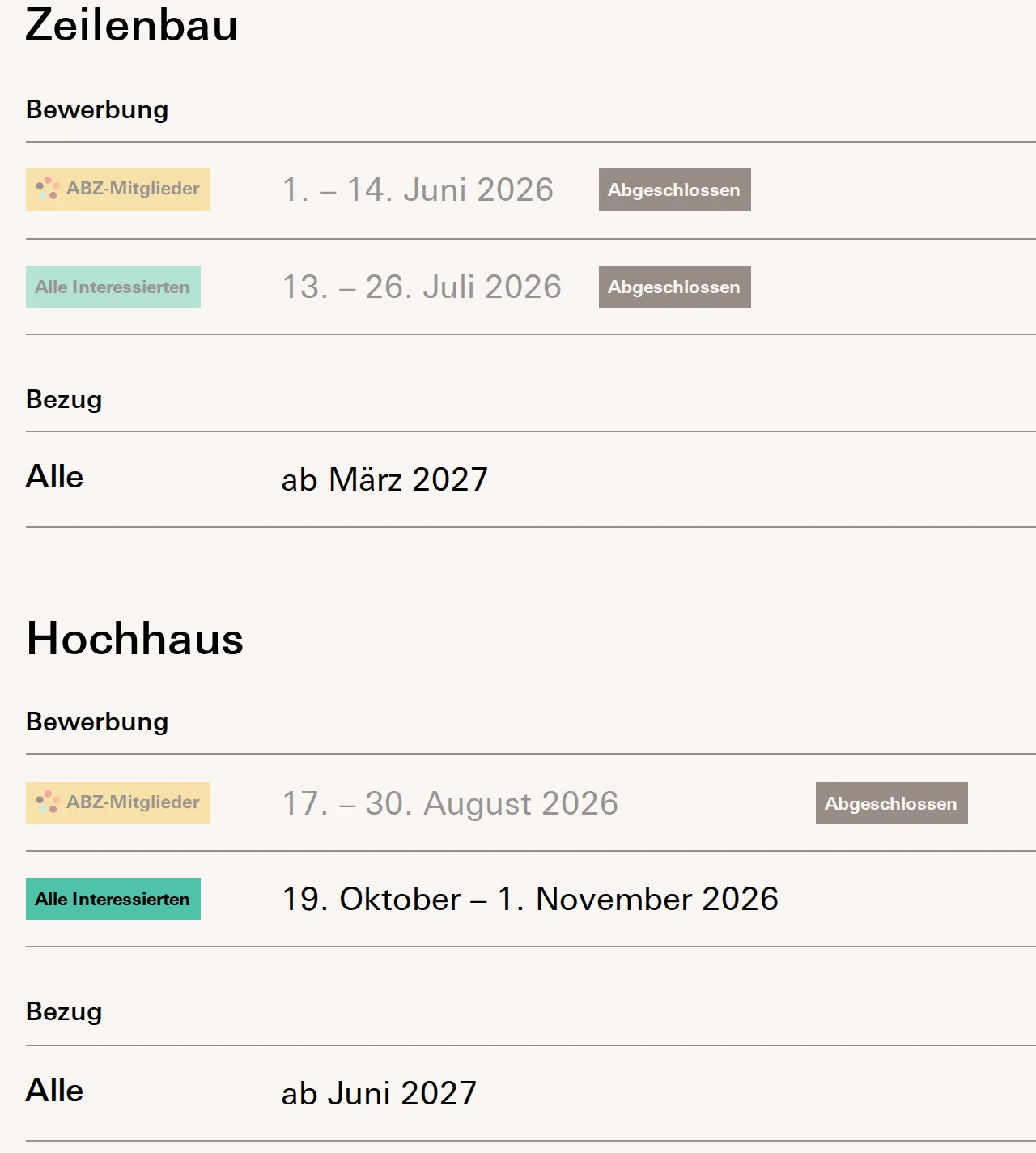
On its letting page, ABZ gives an application window for the tower open to anyone from 19 October to 1 November 2026, with move-in from June 2027. Its own members had the first chance, as they did for the low-rise block, whose flats will be occupied from March 2027. A few rules from the call for applications are worth knowing:
- All applications received within the window are treated equally. It makes no difference whether you apply on the first day or the last.
- You apply for a type of flat, not a specific flat. Several applications per household get you nothing; only one is considered.
- The rule is number of rooms minus one: at least two people must live in a 3.5-room flat.
- A third of the floor space is reserved for subsidised flats.
- The estate is low-car. There are parking spaces for one flat in four, and tenants sign an undertaking not to park a car in the surrounding area.
On the city's side, the Hardau I housing estate is due to be finished in 2026; according to the city, construction runs from 2022 to 2026. It replaces 80 small flats from the 1960s with 122 new ones. The next larger city estate follows in Altstetten: at Salzweg, 230 flats will replace 130 by 2028, around two thirds of them small flats. The city advertises them on its website about six months before move-in.
Many of the cooperative flats under construction have no project name in the statistics, only a location. In Seebach, cooperatives are building 290 flats in the Ausserdorfstrasse zone and 253 in the Köschenrüti zone. In Affoltern there are 274 around Zehntenhausplatz, and in Schwamendingen 266 in the Schürgistrasse zone. The map of non-profit housing providers from the cooperatives' association shows which cooperatives have estates in these neighbourhoods. Among private developers, the largest building sites are in the Mattenhof zone in Hirzenbach (439 flats), the Auhof zone in Schwamendingen (298) and Leutschenbach (252). What comes after that is largely planned already.
What comes from 2028 onwards
The next wave of non-profit new builds will be finished between 2028 and 2031, and for some projects the date is not yet certain.
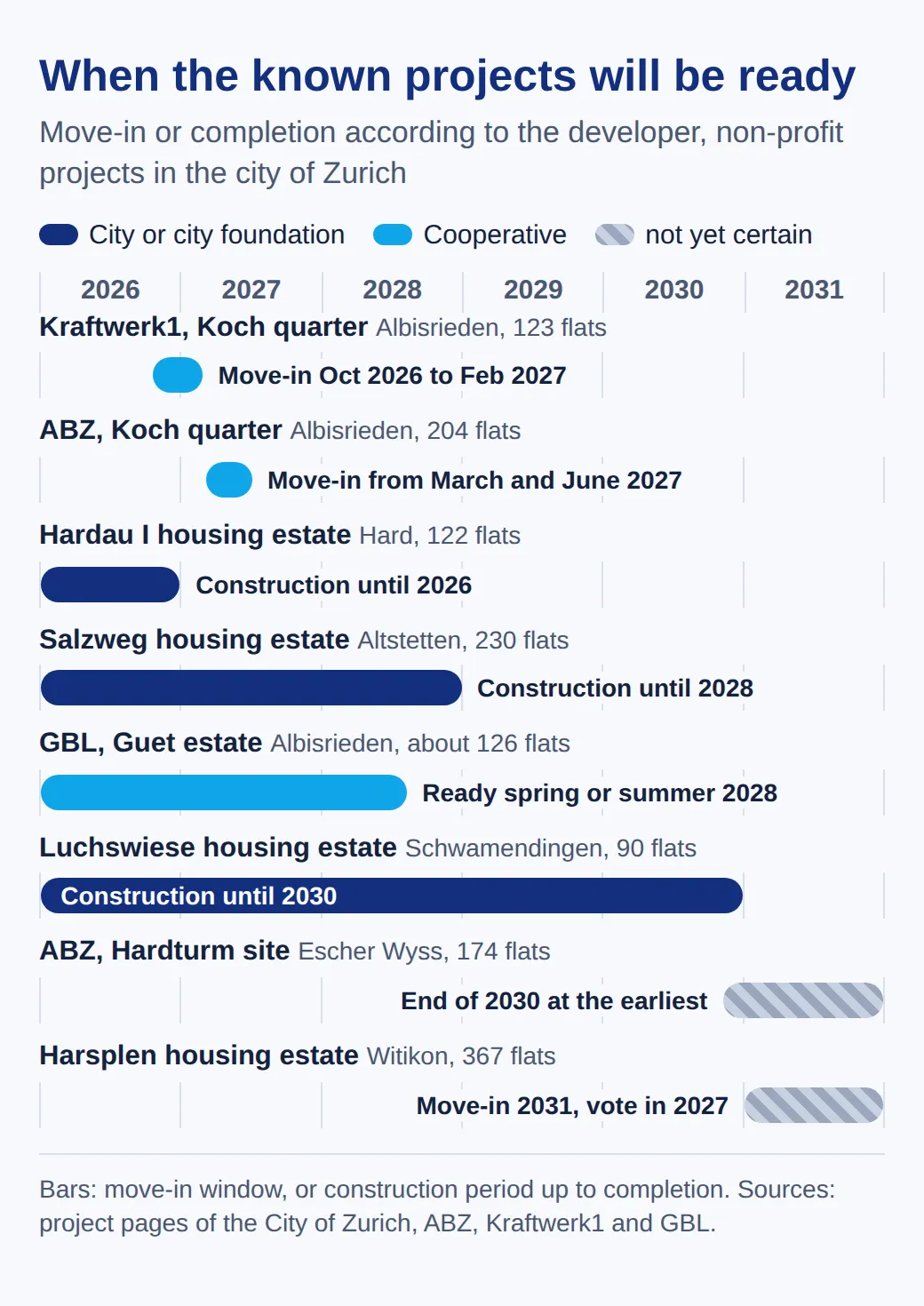
In Albisrieden, the Gemeinnützige Baugenossenschaft Limmattal (GBL) is building around 126 flats in its Guet estate. They are due to be finished in spring or summer 2028, and GBL says it will publish information on the first letting from spring 2027. In Schwamendingen, the city is replacing the Luchswiese estate and its 72 flats in stages with 90 new ones; construction runs until 2030.
In Seebach, a whole new part of the neighbourhood is taking shape on the Thurgauerstrasse site. ABZ is planning around 120 flats there, the cooperatives mehr als wohnen and Grubenacker around 130, and WOGENO together with the Stiftung Familienwohnungen around 160. On top of that come around 132 flats for older people from the city's foundation for senior housing, the Stiftung Alterswohnungen (SAW). The architecture competitions for the mehr als wohnen and WOGENO estates have been decided; the result for the ABZ building is expected in early 2027. The city gives no move-in year for any of these projects. Also in Seebach, in Leutschenbach, SAW is planning the Heidi Abel estate with 110 flats for older people.
The largest city project is in Witikon. On the Harsplen site, 367 flats for around 875 people are planned, the first city-owned estate in the neighbourhood. Voters decide on the funding in June 2027. If they say yes, the first tenants will move in in 2031, and the flats are expected to be advertised in 2030.
For two large ABZ projects, the date is uncertain. On the Hardturm site next to the planned football stadium, 174 flats are planned, but the project is blocked by objections to the development plan. ABZ gives the end of 2030 at the earliest for move-in. It gives the same date for its roughly 205 flats in the Seebahnhöfe project. With all of these projects, it is not just the building that is new, but the price too.
What a new-build flat costs
A private new-build flat is the most expensive way to rent in Zurich. The city's 2026 rent survey estimates a median rent of CHF 38.80 per square metre for new builds that are not non-profit. For a typical 75-square-metre flat, that comes to CHF 2,907 a month in net rent. A new lease in an older building costs a median of CHF 2,287, which is CHF 620 less.
With non-profit landlords, new-build rent is around CHF 20 per square metre, so about CHF 1,487 for the same flat. That is still more than in their older buildings, where the typical flat costs CHF 1,080 to 1,174 depending on how long the lease has run. The city puts the higher new-build rents partly down to construction costs: housing construction prices rose by around 17 percent in six years, general inflation in the city by around 7 percent.
Harsplen shows what that means in practice. The city gives example rents there, net and based on the reference interest rate of 1.25 percent. A 2.5-room flat is set to cost between CHF 1,100 (subsidised) and CHF 1,950, a 4.5-room flat between CHF 1,585 and CHF 2,730.
The high prices also show up in the vacancy figures. On 1 June 2026, only 252 flats stood empty in the whole city, 0.11 percent of the stock. 70 of them were new flats, after 42 the year before, 18 in 2024 and 7 in 2023. Since 2024, the rents of the empty flats have been around CHF 40 per square metre, compared with about CHF 31 before. Because the numbers are small, the city warns against reading too much into them. Still, a pattern is visible: what stands empty is more often new and expensive. Our post on rents by district shows how much rents differ across Zurich. Whether you get a more affordable new-build flat depends mostly on how you apply.
How to get a new-build flat
When a new building is let for the first time, the rules depend on who built it. The cooperatives make the biggest difference. Both cooperatives in the Koch quarter offered their new flats to their own members first. At ABZ in the Koch quarter, members also had to have held a lease for more than five years or already be on the waiting list. If you are new to Zurich, you only get a chance with projects like these in the second round, when the cooperative opens the letting to everyone. Our post on cooperative flats explains how to prepare for that.
The city keeps no waiting list. It advertises new flats publicly and announces them in its Ligi newsletter. For non-subsidised city flats, you must register your residence in Zurich by the start of the lease at the latest. At the start, your income may be no more than four times the gross annual rent, as the letting conditions state. And as with the cooperatives, the rule of number of rooms minus one applies.
Private developers let their new buildings through listings, and you don't need to be a member of anything. At the end of 2025, private owners had 4,464 flats under construction, most of them in Seebach (826), Oerlikon (478), Hirzenbach (439) and Schwamendingen-Mitte (430). Here, a complete application file and a quick reply are what count.
So set up a search alert for the districts where building is going on, and keep your application file ready: an extract from the debt collection register (Betreibungsauszug), proof of salary and a copy of the passport or ID card of everyone in the household. ABZ, for example, asks for a debt collection extract no older than three months for the Koch application.
What you can do now
Choose the area first. If you search in the north and west, in Seebach, Oerlikon, Affoltern, Altstetten, Albisrieden or Schwamendingen, you will have the most new flats to choose from over the next two years. If you only want to live in the Old Town or in Riesbach, you will find hardly any new builds there.
Then note the fixed dates. ABZ accepts applications from anyone for its Koch tower from 19 October to 1 November 2026. GBL will publish information on the Guet estate from spring 2027. The city advertises Salzweg around six months before move-in. Subscribe to the city's Ligi newsletter and to the newsletters of the cooperatives building in the neighbourhood you want.
And once you have secured a new flat, it is time to move. Our post on moving in Zurich covers what you need to take care of in the city.
Common questions
How many new flats for sale are built in Zurich each year?
Very few. According to the city's open data, only 333 new flats in condominium ownership were completed in 2025, after 184 in 2024 and 366 in 2023. The rest of the 2,600 to 3,000 new flats a year belong to companies, cooperatives, the public sector or private individuals.
What is the difference between an approved project and one under construction?
Approved means the building permit has been granted but work has not started. Under construction means work has begun. Years can pass between the two. Some projects stall even earlier: ABZ's Hardturm site is blocked by objections to its development plan, and ABZ expects the first tenants to move in at the end of 2030 at the earliest.
Do I need to live in Zurich already to rent a new city-owned flat?
No. For a non-subsidised city flat, you must register your residence in Zurich by the start of the lease at the latest, and it may not be a second home. Students and trainees may register as weekly residents for no more than six years. For subsidised flats, you must have lived in the canton of Zurich for at least two years before the lease starts, and income and assets are capped.
Why does Zurich demolish so many buildings instead of renovating them?
Because building land has become scarce, as the city itself puts it, and because a new building on the same plot usually holds more flats. At the Salzweg estate, the city is replacing 130 flats with 230. It also cites structural defects: the prefabricated 1960s elements can hardly be renovated, and requirements such as step-free access could only be met in the old building at high cost.
More from the blog
All posts
Renting in Zurich with debt collection entries (Betreibung)
Renting in Zurich with a Betreibung on your extract: what landlords see, how to get disputed entries hidden under the 2026 rules, and who still rents to you.

Renting with a dog in Zurich: landlord consent and dog tax
Dog or cat in a Zurich rental: when your landlord can say no, what you pay for damage on moving out, plus registration, the CHF 160 dog tax and banned breeds.

Challenging the initial rent in Zurich: deadline, form, odds
How to challenge your initial rent in the canton of Zurich: the 30-day deadline, what the form must show, comparable rents and 2025 conciliation results.