Weekly resident in Zurich: registration, tax, housing

Before you register
As a weekly resident, you register with the City of Zurich's Residents' Registration Office (Personenmeldeamt) within 14 days of moving in, by appointment. You bring the residence certificate from your home municipality (formerly called Heimatausweis) and pay CHF 60 a year. You then keep paying tax at home, but only as long as your life genuinely takes place there. If you have a permanent job in Zurich, the city usually won't grant weekly residence at all.
Many guides treat weekly residence (Wochenaufenthalt) as a form you fill in to save tax by staying taxed at home. In Zurich, though, the registration office checks whether the centre of your life really lies outside the city, and it follows the case law of the Federal Supreme Court in doing so. We show who gets weekly residence, how registration works, when Zurich taxes you, which extra costs you can deduct and what kind of home suits this way of living. The flat you rent can itself become an argument when the tax office decides where you belong. The official pages we link are in German unless we say otherwise.
Who counts as a weekly resident in Zurich
Weekly residents have their domicile outside the city and need a second place in Zurich because they work here, train here or live in an institution here. That is how the City of Zurich's page on weekly residence puts it. They only stay here on working or study days and go back to their domicile on their days off.
The city explicitly calls weekly residence a temporary arrangement. The reasons must be clear to outsiders, too; purely personal motives or wishes don't count. Preferring to stay registered at home is not enough. Under the cantonal registration law, you have to give information about your living and working situation, and the office may ask for proof.
The city's register shows who actually holds weekly residence. We analysed the data set Wochenaufenthalter*innen on Zurich's open data portal. In 2025, 13,650 people were registered as weekly residents, around 5,900 fewer than in 2000, when the figure stood at 19,553, the highest in the series going back to 1993.
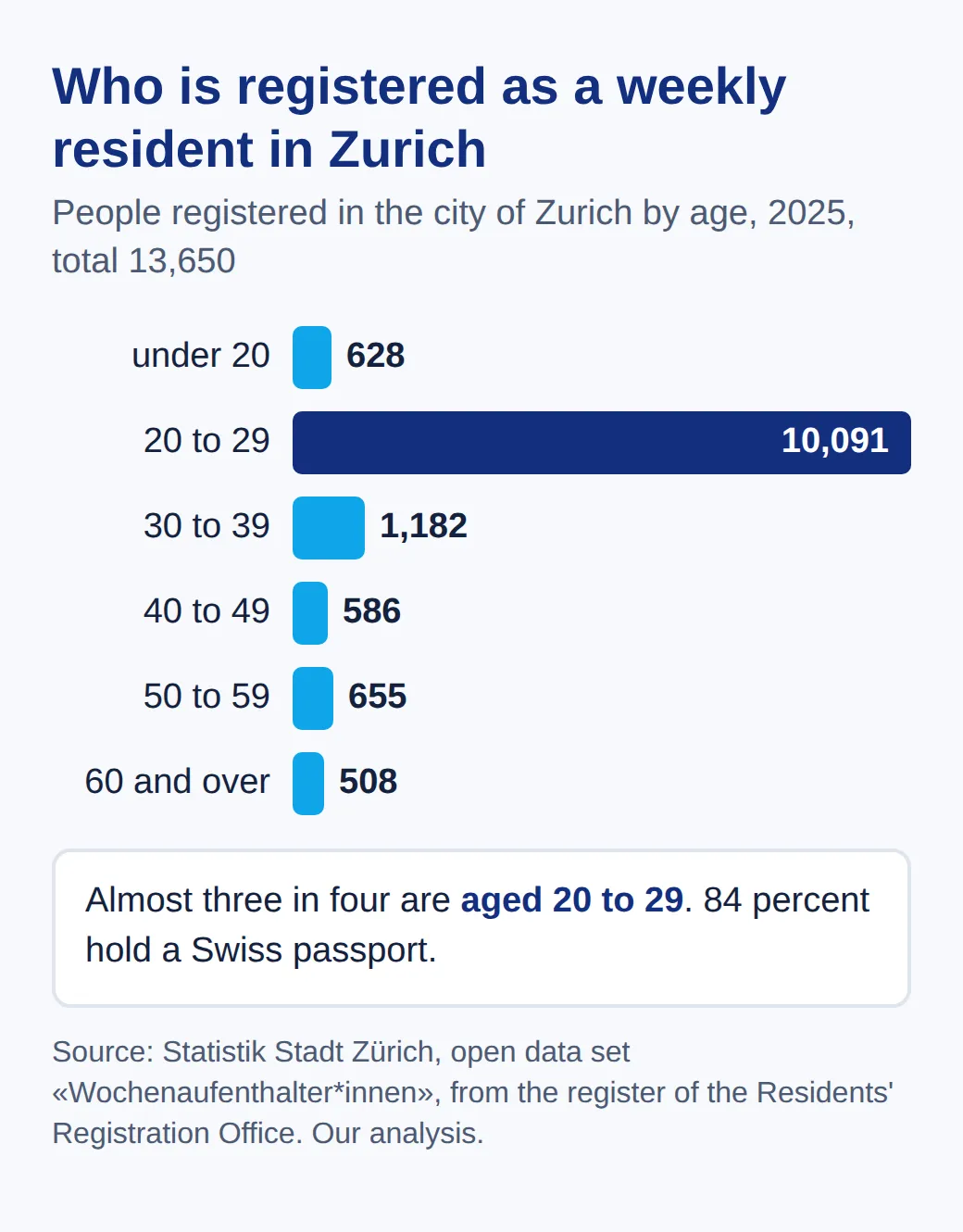
Almost three quarters are between 20 and 29. The statistics don't record occupations, but the picture fits students and trainees. Only 1,182 are in their thirties. Most come from other cantons, above all from Ticino (1,497), Graubünden (1,173) and St. Gallen (1,073). Another 2,523 come from other municipalities in the canton of Zurich. The district with the most weekly residents is Kreis 11, with Oerlikon, Seebach and Affoltern, at 3,110. There's a reason why working people in mid-career are so rare.
Permanent job in Zurich: usually no weekly residence
If you have a permanent job in Zurich, you usually won't be granted weekly residence. The city says so twice, in the section on extensions and in its frequently asked questions. According to the city, weekly residence is meant for studies, initial vocational training and temporary work with no intention of staying longer.
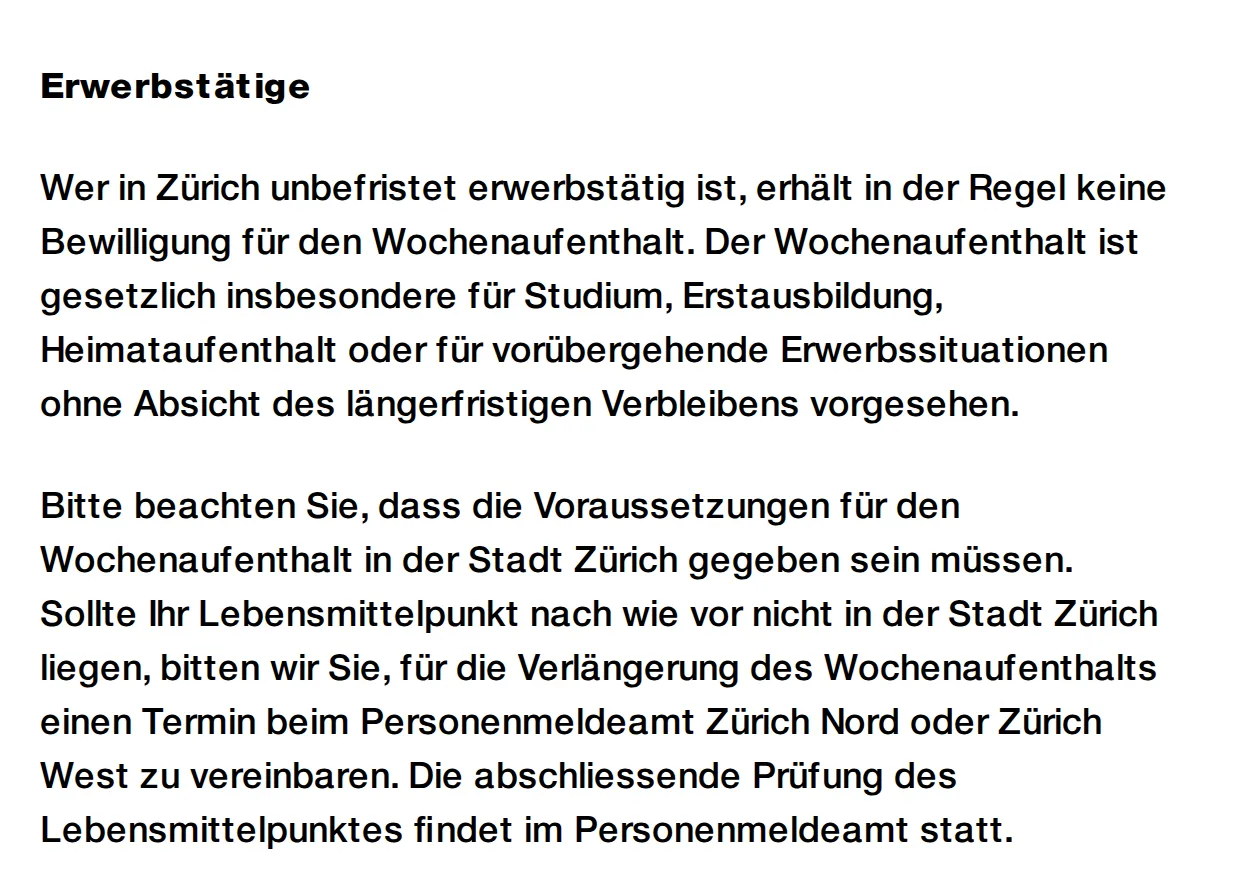
For you, this means that a permanent employment contract with a Zurich employer is the strongest sign that your life is shifting to Zurich. A fixed-term contract, an assignment with a foreseeable end or a family living in the other place fit weekly residence better. The city says the final check on the centre of your life (Lebensmittelpunkt) takes place at the registration office. So prepare documents that show why you go home every weekend.
If the office says no, you register your main residence in Zurich instead (Niederlassung). For that, you first have to deregister from your old municipality. How that works and what a normal move to Zurich costs is in our article on moving in Zurich. Everyone else moves on to booking an appointment.
Registering with the Residents' Registration Office
You register within 14 days, at the earliest on the day you actually move in. You can no longer register without an appointment: the city has recently made them compulsory. You book one online through the city's page. Note that one office is moving: from 2 November 2026, the Residents' Registration Office in Zürich West is at Hardstrasse 41, and the office at Hohlstrasse 35 closes.
For the appointment, you need these documents:
- passport or ID card, plus your residence permit card if you aren't Swiss
- the residence certificate (Aufenthaltsausweis, formerly Heimatausweis) from the municipality of your main residence
- your lease, a sublease, a housing certificate (Wohnungsausweis) or a move-in confirmation from your landlord
- your confirmation of enrolment or student card if you're studying
The residence certificate is the key document. It confirms that you are registered somewhere else, and you order it there, not in Zurich. Some municipalities call it something else, so ask them for the document you need for weekly residence. If you go in person, the city wants the original. Its validity matters too: the city grants weekly residence for no longer than the certificate is valid, and for foreign nationals no longer than their permit either.
The city itself warns that appointments are sometimes not available until after the 14 days have run out. In that case, book the next available appointment anyway and also ask for an extension of the deadline through the city's contact form. The office works in German, so a German version is the safe choice, and a few sentences are enough:
Guten Tag. Ich bin am 1. November 2026 als Wochenaufenthalter an die Musterstrasse 12, 8050 Zürich, gezogen. Der nächste freie Termin beim Personenmeldeamt ist am 24. November 2026, und ich habe ihn gebucht. Ich bitte um eine Verlängerung der Meldefrist bis zu diesem Termin. Freundliche Grüsse
In English: you moved to Musterstrasse 12, 8050 Zürich, as a weekly resident on 1 November 2026, the next free appointment is on 24 November 2026 and you have booked it, and you ask for the registration deadline to be extended until then.
The fee is CHF 60 a year. If you hold a cross-border commuter permit, registration works differently: in person at the Residents' Registration Office in Zürich Süd, with an appointment for arrivals from abroad («Zuzug aus dem Ausland»). Once weekly residence is granted, the next question is how long it lasts.
Extending and deregistering
Weekly residence is not open-ended. How long it lasts depends on your reason and on how long your residence certificate is valid. If one of the documents is only valid for a year, your weekly residence also ends after a year.
Students can extend online if they study full time and work little or not at all on the side. The page on extensions lists what you need: a login for the city's «Mein Konto» account, proof of enrolment, the residence certificate, your AHV number (the social security number) and a credit card. The extension is for four years at most and never beyond the end of your studies. The request must arrive no later than 14 days after expiry, and it again costs CHF 60.
Everyone else extends in person, by appointment at Zürich Nord or West. There, the centre of your life is checked again. If you take a permanent job in Zurich after your studies, expect the city not to extend your weekly residence.
If you move away, deregister your weekly residence within 14 days. You can do this in writing, by sending the deregistration form (Abmeldeerklärung) through the contact form, at the earliest 30 days before you move out, or with an appointment. Registering with the city, though, only settles half the question. The other half is for the tax office, and it makes up its own mind.
Where you pay tax
You pay tax where the centre of your life is, and the tax authorities decide this from the facts, not from your wishes. The Swiss Civil Code defines domicile as the place where you reside with the intention of settling (link in English), and the Federal Act on Direct Federal Taxation uses the same formula. The Civil Code also states that staying somewhere for education or training does not by itself establish domicile. For students, the situation is therefore usually clear.
For employees, it's trickier. The Federal Supreme Court summed up its case law in the leading ruling BGE 125 I 54. If you spend your time alternately in two places, you are liable to tax where your ties are stronger. What counts are the objective circumstances, and the court states that your tax domicile is "cannot be freely chosen". For employees, it is in principle at the place of work.
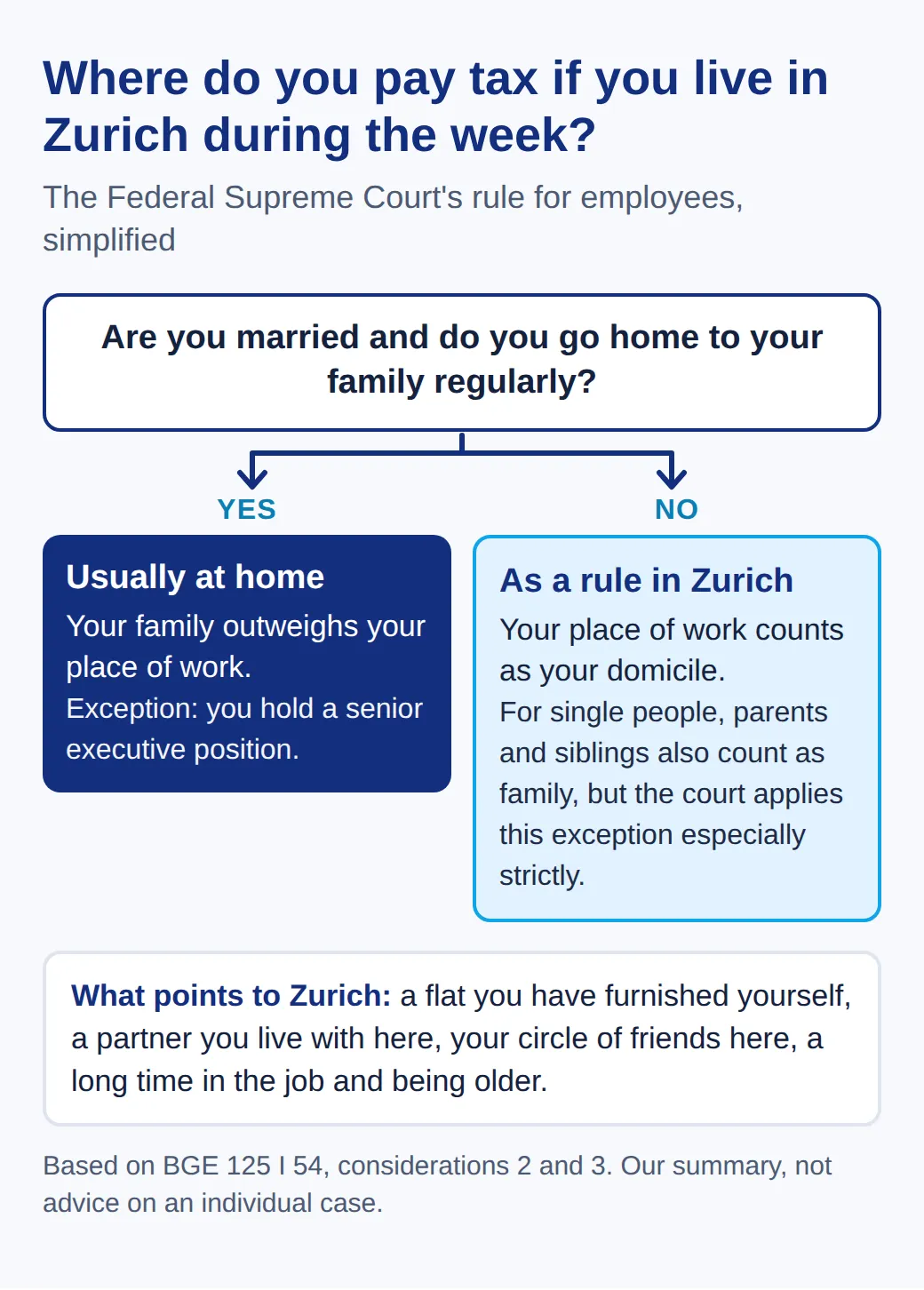
There is an exception for everyone who goes home to their family regularly, but it helps married people much more than single ones. If you're married and go back to your family every day or regularly at weekends, you usually pay tax where your family lives. In principle, this only changes if you work in a senior executive position. The exception also applies to single people, since parents and siblings count as family too, but the court examines it "particularly strictly". Even if you visit your parents every weekend, you can become liable to tax at your place of work, for example if you have furnished a flat there, live with someone there or have your own circle of friends there. According to the court, the length of employment and your age carry particular weight.
Single people also carry the burden of proof. If you don't visit family at the weekend, the place you go back to only becomes your tax domicile in exceptional cases, and it is up to you to prove that the centre of your life lies somewhere other than your place of work. It isn't up to the canton where you work to prove that you belong to it.
A case with a Zurich connection
The man at the centre of BGE 125 I 54 spent his weekends in the canton of Zurich and worked in Basel. He was single, 40 years old and had been with his employer for almost two and a half years. He had registered in Basel as a weekly resident and wanted to pay his taxes in his Zurich municipality, where he also held citizenship.
The Federal Supreme Court ruled for Basel. In Basel, he was already living in his third flat, with two rooms he had furnished himself. His steady relationship counted for little, because both partners had a flat of their own. Choir rehearsals in Zurich and his local citizenship weren't enough either. That he had only gone to Basel after losing a job and wanted to return soon made no difference to the court. After two and a half years, it said, it could no longer be called a mere stopgap.
The same applies the other way round in Zurich. If you've worked here a long time, are single and spend your weekends in an empty flat, expect the Zurich tax office to see you as a Zurich taxpayer. If your tax domicile is at home, however, you can deduct the extra costs of your stay in Zurich.
What you can deduct as a weekly resident
If you have to stay overnight at your place of work during the week and regularly go back to your tax domicile, you can deduct the extra costs. For direct federal tax, this is set out in the federal ordinance on professional expenses (Berufskostenverordnung, not published in English). For cantonal and municipal taxes, the law of the canton where you are domiciled applies. If you live in the canton of Zurich and stay in the city during the week, the rates in the Zurich tax return guide for 2025 (Wegleitung zur Steuererklärung) apply:
| Item | Direct federal tax | Zurich cantonal tax |
|---|---|---|
| Meals | CHF 30 a day, at most CHF 6,400 a year | Dinner CHF 15 per working day, at most CHF 3,200, plus lunch as for all employees |
| Accommodation | the usual local cost of a room | rent for a room |
| Trip home | public transport, at most CHF 3,300 including all travel costs | public transport, at most CHF 5,200 including all travel costs |
For meals, the amounts are flat rates; for federal tax you can't claim higher costs even with receipts. If your employer subsidises one of the two main meals, for example through a canteen or vouchers, the federal deduction falls to CHF 22.50 a day or CHF 4,800 a year. For cantonal tax, lunch counts as it does for all employees who can't go home at midday: CHF 15 per working day, or CHF 7.50 if your meal is subsidised. For the trip home, Zurich usually only accepts public transport, a GA travelcard for example. On the professional expenses form («Berufsauslagen»), the trip home goes under item 1, lunch under item 2, and the room and dinner, with a separate list, under item 4. The caps on travel costs are unchanged on the form for 2026.
There is another side to the room rule. What you can deduct is the usual local cost of a room, not the rent for a whole flat. If you rent a 2.5-room flat in Zurich, the rest is a private expense. And a flat of your own that you have furnished yourself is exactly one of the signs the Federal Supreme Court names for a centre of life at the place of work. So choosing a home is not just a matter of taste.
What kind of home suits weekly residence
For most weekly residents, a furnished room or a small fixed-term flat suits best. A room is exactly what tax law accepts as accommodation, and both are easy to give up once the reason for your weekly residence ends. The notice rules are what matter, because they decide how quickly you are free again.
You and your landlord can end the lease on a furnished room with two weeks' notice to the end of a one-month period of the lease (Art. 266e CO), unless the contract sets a longer period. That's ideal if an assignment ends at short notice. The downside: your landlord can give you notice just as quickly. Ask for a written contract all the same, because the registration office wants to see a lease, a sublease or a move-in confirmation.
A studio or small flat with a fixed end date ends on the agreed day without any notice (Art. 266 CO). That suits a project with an end date. You can only get out earlier by proposing a replacement tenant whom the landlord can reasonably accept, who is solvent and who takes over the lease on the same terms (Art. 264 CO). What else applies to fixed-term leases is in our article on fixed-term flats and sublets.
A sublet, including a temporary one, is often the quickest way to a room in a flatshare or a flat for a limited time. It needs the landlord's consent (Art. 262 CO), and your rights depend on the main lease. Ask about that consent before you say yes, or you'll turn up to register with a document nobody has approved.
You end an ordinary open-ended lease with three months' notice to a termination date set by local custom (Art. 266c CO). If your weekly residence ends unexpectedly, in the worst case you'll keep paying rent for months. Be careful, too, with offers described as holiday flats: the protective rules for residential leases don't apply to holiday flats rented for three months or less (Art. 253a CO).
Non-profit flats are mostly closed to weekly residents. The city does not allow a secondary residence in its flats: tenants must register their residence in Zurich by the start of the lease at the latest. The exception is people in education or training, who may register as weekly residents for no more than six years. Cooperatives can also require you to be domiciled in the flat. The tenants' building cooperative Mieterbaugenossenschaft Zürich, for example, states in its letting rules that its members must have their legal domicile there. How cooperatives allocate their flats in general is in our article on finding a cooperative flat in Zurich.
What you can do now
First, work out whether your situation really is weekly residence. If you have a permanent job in Zurich and no family in the other place, registering your main residence here is usually the more honest route, and in the end also the simpler one. If weekly residence fits, order the residence certificate from your municipality as soon as you have your lease, and book an appointment with the Residents' Registration Office early, for a day shortly after you move in.
For tax, keep your records from the first month: the lease for the room, the travel pass for the trip home and a simple list of your working days in Zurich. Check every year whether your life has shifted, for example through a relationship here, a bigger flat or a contract that has become permanent. If it has, change your registration yourself before the tax office decides for you.
Common questions
How much does it cost to register as a weekly resident in Zurich?
The city charges CHF 60 a year, when you register and again each time you extend. On top of that comes the residence certificate, which you order from your home municipality. That municipality sets its own fee for it.
What happens if Zurich refuses my weekly residence?
Then the office considers the centre of your life to be in Zurich, and you register Zurich as your main residence (Niederlassung). To do that, you first deregister from your old municipality, either online through eUmzug or with an appointment. If the centre of your life is in Zurich, Zurich will usually be in charge of your taxes as well.
Can a cross-border commuter register as a weekly resident in Zurich?
Yes, if you hold a valid cross-border commuter permit. You register in person at the Residents' Registration Office in Zürich Süd, booking an appointment for arrivals from abroad. Bring your passport or ID card, the permit, your lease and CHF 60. Cross-border commuters have their own tax rules, which this article does not cover.
How long can a student stay registered as a weekly resident in Zurich?
The city extends online by four years at most, and never beyond the end of your studies or the validity of your residence certificate. Once you graduate, the office checks your case again. If you then take a permanent job in Zurich, you will usually no longer get weekly residence.
More from the blog
All posts
Fixed-term lease in Zurich: rights, deadlines, sublets
Fixed-term lease or sublet in Zurich: when it ends, how to move out early, when you can get an extension and which traps to watch for.

Renting in Zurich with debt collection entries (Betreibung)
Renting in Zurich with a Betreibung on your extract: what landlords see, how to get disputed entries hidden under the 2026 rules, and who still rents to you.

Renting with a dog in Zurich: landlord consent and dog tax
Dog or cat in a Zurich rental: when your landlord can say no, what you pay for damage on moving out, plus registration, the CHF 160 dog tax and banned breeds.